Thursday, January 31, 2019

Where to retire?

So you are thinking about retiring…

You can retire to Phoenix, Arizona where...
1. You are willing to park 3 blocks away because you found shade.
2. You've experienced condensation on your hiney from the hot water in the toilet bowl.
3. You can drive for 4 hours in one direction and never leave town.
4. You have over 100 recipes for Mexican food.
5. You know that "dry heat" is comparable to what hits you in the face when you open your oven door.
6. The 4 seasons are: tolerable, hot, really hot, and ARE YOU KIDDING ME??!!

OR

You can retire to California where...
1. You make over $250,000 and you still can't afford to buy a house.
2. The fastest part of your commute is going down your driveway.
3. You know how to eat an artichoke.
4. You drive your rented Mercedes to your neighborhood block party.
5. When someone asks you how far something is, you tell them how long it will take to get there rather than how many miles away it is.
6. The 4 seasons are: Fire, Flood, Mud, and Drought.

OR

You can retire to New York City where...
1. You say "the city" and expect everyone to know you mean Manhattan.
2. You can get into a four-hour argument about how to get from Columbus Circle to Battery Park, but can't find Wisconsin on a map.
3. You think Central Park is "nature."
4. You believe that being able to swear at people in their own language makes you multi-lingual.
5. You've worn out a car horn. (Ed. Note if you have a car).
6. You think eye contact is an act of aggression.

OR

You can retire to Minnesota where...
1. You only have four spices: salt, pepper, ketchup, and Tabasco.
2. Halloween costumes fit over parkas.
3. You have more than one recipe for casserole.
4. Sexy lingerie is anything flannel with less than eight buttons.
5. The four seasons are: winter, still winter, almost winter, and construction.

OR

You can retire to the Deep South where....
1. You can rent a movie and buy bait in the same store.
2. "Y'all" is singular and "all y'all" is plural.
3. "He needed killin" is a valid defense.
4. Everyone has 2 first names: Billy Bob, Jimmy Bob, Mary Ellen, Betty Jean, Mary Beth, etc. etc
5. Everything is either "in yonder," "over yonder" or "out yonder."
It's important to know the difference, too.

OR

You can retire to (Boulder) Colorado where....
1. You carry your $3,000 mountain bike atop your $500 car.
2. You tell your husband to pick up Granola on his way home and so he stops at the day care center.
3. A pass does not involve a football or dating.
4. The top of your head is bald, but you still have a pony tail.

OR

You can retire to the Midwest where...
1. You've never met any celebrities, but the mayor knows your name.
2. Your idea of a traffic jam is ten cars waiting to pass a tractor.
3. You have had to switch from "heat" to "A/C" on the same day.
4. You end sentences with a preposition: "Where's my coat at?"
5. When asked how your trip was to any exotic place, you say, "It was different!"

OR

Lastly, you can retire to Florida where...
1. You eat dinner at 3:15 in the afternoon.
2. All purchases include a coupon of some kind -- even houses and cars.
3. Everyone can recommend an excellent dermatologist.
4. Road construction never ends anywhere in the state.
5. Cars in front of you often appear to be driven by headless people.


Wednesday, January 30, 2019

Where is Governor Walker when you need him?


The real question: How much has already been spent for infrastructure etc, by State of Wisconsin, counties and cities on the project?


Exclusive: Foxconn reconsidering plans to make LCD panels at Wisconsin plant

Jess Macy Yu, Karl Plume

5 MIN READ

(Reuters) - Foxconn Technology Group is reconsidering plans to make advanced liquid crystal display panels at a $10 billion Wisconsin campus, and said it intends to hire mostly engineers and researchers rather than the manufacturing workforce the project originally promised.

FILE PHOTO: A shovel and FoxConn logo are seen before the arrival of U.S. President Donald Trump as he participates in the Foxconn Technology Group groundbreaking ceremony for its LCD manufacturing campus, in Mount Pleasant, Wisconsin, U.S., June 28, 2018. REUTERS/Darren Hauck

Announced at a White House ceremony in 2017, the 20-million square foot campus marked the largest greenfield investment by a foreign-based company in U.S. history and was praised by President Donald Trump as proof of his ability to revive American manufacturing.

Foxconn, which received controversial state and local incentives for the project, initially planned to manufacture advanced large screen displays for TVs and other consumer and professional products at the facility, which is under construction. It later said it would build smaller LCD screens instead.

Now, those plans may be scaled back or even shelved, Louis Woo, special assistant to Foxconn Chief Executive Terry Gou, told Reuters. He said the company was still evaluating options for Wisconsin, but cited the steep cost of making advanced TV screens in the United States, where labor expenses are comparatively high.

“In terms of TV, we have no place in the U.S.,” he said in an interview. “We can’t compete.”


When it comes to manufacturing advanced screens for TVs, he added: “If a certain size of display has more supply, whether from China or Japan or Taiwan, we have to change, too.”

Rather than a focus on LCD manufacturing, Foxconn wants to create a “technology hub” in Wisconsin that would largely consist of research facilities along with packaging and assembly operations, Woo said. It would also produce specialized tech products for industrial, healthcare, and professional applications, he added.

“In Wisconsin we’re not building a factory. You can’t use a factory to view our Wisconsin investment,” Woo said.

Earlier this month, Foxconn, a major supplier to Apple Inc., reiterated its intention to create 13,000 jobs in Wisconsin, but said it had slowed its pace of hiring. The company initially said it expected to employ about 5,200 people by the end of 2020; a company source said that figure now looks likely to be closer to 1,000 workers.

It is unclear when the full 13,000 workers will be hired.

But Woo, in the interview, said about three-quarters of Foxconn’s eventual jobs will be in R&D and design - what he described as “knowledge” positions - rather than blue-collar manufacturing jobs. Foxconn is formally known as Hon Hai Precision Industry Co.

Rather than manufacturing LCD panels in the United States, Woo said it would be more profitable to make them in greater China and Japan, ship them to Mexico for final assembly, and import the finished product to the United States.

He said that would represent a supply chain that fits with Foxconn’s current “fluid, good business model.”

Heavily criticized in some quarters, the Foxconn project was championed by former Wisconsin Governor Scott Walker, a Republican who helped secure around $4 billion in tax breaks and other incentives before leaving office. Critics of the deal, including a number of Democrats, called it a corporate giveaway that would never result in the promised manufacturing jobs and posed serious environmental risks.

The company’s own growth projections and employment goals suggest the taxpayer investment would take at least 25 years to recoup, according to budget think tank the Wisconsin Budget Project.

Foxconn CEO Gou plans to meet with Wisconsin’s new Democratic governor, Tony Evers, a past critic of the deal, later this year to discuss modifications of the agreement, according to the source familiar with the company’s thinking.

U.S., China face major differences amid trade talks

Evers could not be reached for comment.

Currently, to qualify for the tax credits Foxconn must meet certain hiring and capital investment goals. It fell short of the employment goal in 2018 - hiring 178 full-time jobs rather than the 260 targeted - failing to earn a tax credit of up to $9.5 million.

The company may be prepared to walk away from future incentives if it is unable to meet Wisconsin’s job creation and capital investment requirements, according to the source familiar with the matter.

Reporting by Jess Macy Yu in Taipei and Karl Plume in Wisconsin; Editing by Jonathan Weber and Paul Thomasch

Our Standards:The Thomson Reuters Trust Principles.

Above is from:  https://www.reuters.com/article/us-foxconn-wisconsin-exclusive/exclusive-foxconn-reconsidering-plans-to-make-lcd-panels-at-wisconsin-plant-idUSKCN1PO0FV


Wisconsin Is Finally Facing the Reality of Foxconn’s Plans

Tim Culpan

,

BloombergJanuary 30, 2019

Wisconsin Is Finally Facing the Reality of Foxconn’s Plans

More

(Bloomberg Opinion) -- So Foxconn Technology Group may not make display panels in Wisconsin after all.

Those who’ve been following Foxconn for a long time won’t be surprised. Chairman and founder Terry Gou is as much a salesman as he is a manufacturer, having spent decades honing his pitch not just to clients but also governments. 

Then-Governor Scott Walker, backed by President Donald Trump, loved exactly what he sold: the promise of thousands of jobs to make stuff in the U.S. Walker loved it so much that he pledged as much as $3 billion in sweeteners, a deal that likely cost him his governorship.

Now, according to a Reuters interview with one of Gou’s right-hand men, such plans to manufacture display panels may be scaled back or even shelved.

“In Wisconsin we’re not building a factory. You can’t use a factory to view our Wisconsin investment,” Louis Woo was cited as saying. Woo was one of the key architects and negotiators behind Foxconn’s deal with the state.

Foxconn’s Wisconsin-made screens likely would have been put into televisions. Woo this week admitted that “in terms of TV, we have no place in the U.S. … We can’t compete.”

If Foxconn can’t be competitive making electronics in the U.S., nobody can.

Woo’s admission doesn’t appear to come from any change in Foxconn’s deal with Wisconsin, or even any shift in the macroeconomic environment. It’s simply a matter of economic reality. The same reality that existed when Trump was handing out red truckers hats and promising to Make America Great Again.

Two years ago this week I wrote that Foxconn’s U.S. panel project didn’t make sense, evidenced by a comment Gou himself made saying that such plans weren’t a promise but a wish.

Wishes don’t always come true. I believe now, as I did then, that it would not be in Wisconsin’s interests to be closely tied to the flat-panel industry because it’s a highly cyclical, cost-sensitive business. One that would likely see massive job cuts not long after large-scale hiring.

Foxconn is now publicly conceding that manufacturing panels in Wisconsin isn’t viable, but still thinks it can hire just as many as originally promised. Instead of factory workers, Woo said they’ll hire for research positions as well as back-end packaging and assembly employees. Frankly, that’s wishful thinking because the U.S. doesn’t have much of a talent pool to dabble in these areas.

In 2018, the first year of the Wisconsin experiment, the company couldn’t even hit its employment target. Instead of creating a very modest 260 full-time jobs, Foxconn filled just 178 positions, Reuters reported.

Now that Foxconn is acknowledging the truth about manufacturing in America, it might be time for the country to face that same reality.


This column does not necessarily reflect the opinion of the editorial board or Bloomberg LP and its owners.

Tim Culpan is a Bloomberg Opinion columnist covering technology. He previously covered technology for Bloomberg News.

For more articles like this, please visit us at bloomberg.com/opinion

©2019 Bloomberg L.P.

Above is from:  https://news.yahoo.com/wisconsin-finally-facing-reality-foxconn-081006427.html


Foxconn pulls back on its $10 billion factory commitment


Danny Crichton@dannycrichton / 5 hours ago

Comment
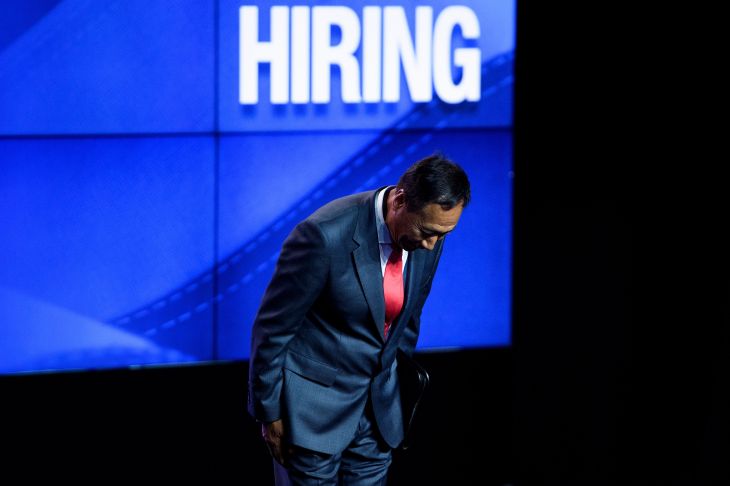
US-POLITICS-ECONOMY-FOXCONN-ENTERPRISES

Well that didn’t last long.

In 2017, Foxconn announced the largest investment of a foreign company in the United States when it selected Mount Pleasant, Wisconsin for a new manufacturing facility. Buttressed by huge economic development grants from Wisconsin, an endorsement from President Trump, and Foxconn CEO Terry Gou’s vision of a maker America, the plant was designed to turn a small town and its environs into the futuristic “Wisconn Valley.”

Now, those dreams are coming apart faster than you can say “Made in America.”

In an interview with Reuters, a special assistant to Gou says that those plans are being remarkably scaled back. Originally designed to be an advanced LCD factory, the new Foxconn facility will instead be a much more modest (but still needed!) research center for engineers.

It’s a huge loss for Wisconsin, but the greater shock may be just how obvious all of this was. I wrote about the boondoggle just a few weeks ago, as had Bruce Murphy at The Verge a few weeks before that. Sruthi Pinnamaneni produced an excellent podcast on Reply All about how much the economic development of Mount Pleasant tore the small town asunder.

The story in short: the economics of the factory never made sense, and economics was always going to win over the hopes and dreams of politicians like Wisconsin governor Scott Walker, who championed the deal. Despite bells and whistles, televisions are a commodity product (unlike, say, airfoils), and thus the cost structure is much more compatible with efficient Asian supply chains than with American expensive labor.

Yet, that wasn’t the only part of the project that never made any sense. Foxconn was building in what was essentially the middle of nowhere, without the sort of dense ecosystem of suppliers and sub-suppliers required for making a major factory hum. (Plus, as a native of Minnesota, I can also attest that Wisconsin is a pile of garbage).

Those suppliers are everything for manufacturers. Just this past weekend, Jack Nicas at the New York Times observed that Apple’s advanced manufacturing facility in Austin, Texas struggled to find the right parts it needed to assemble its top-of-the-line computer, the Mac Pro:

But when Apple began making the $3,000 computer in Austin, Tex., it struggled to find enough screws, according to three people who worked on the project and spoke on the condition of anonymity because of confidentiality agreements.

In China, Apple relied on factories that can produce vast quantities of custom screws on short notice. In Texas, where they say everything is bigger, it turned out the screw suppliers were not.

There are of course huge manufacturing ecosystems in the United States — everything from cars in Detroit, to planes in Washington, to advanced medical devices in several major bio-hubs. But consumer electronics is one that has for the most part been lost to Singapore, Taiwan, Korea, and of course, China.

Geopolitically, Foxconn’s factory made a modicum of sense. With the increasing protectionism emanating from Western capitals, Foxconn could have used some geographical diversity in the event of a tariff fight. The company is Taiwanese, but manufacturers many of its products on the mainland.

And of course, a research center is still an enormous gain for a region of Wisconsin that could absolutely use high-income, professional jobs. Maybe the process of rolling out a next-generation manufacturing ecosystem will take more time than originally anticipated, but nothing is stopping further expansion in the future.

Yet, one can’t help but gaze at the remarkable naïveté of Wisconsin politicians who offered billions only to find that even massive subsidies aren’t enough. It’s a competitive world out there, and the United States has little experience in these fights.

Above is from:  https://techcrunch.com/2019/01/30/foxconn-pulls-back-on-its-10-billion-dollar-factory-commitment/?yptr=yahoo

Monday, January 28, 2019

Can Border Patrol and ICE grow? Are there employees wanting these jobs?


Trump ordered 15,000 new border and immigration officers — but got thousands of vacancies instead

By MOLLY O'TOOLECan

JAN 27, 2019 | 3:00 AM

| WASHINGTON

Trump ordered 15,000 new border and immigration officers — but got thousands of vacancies instead

A U.S. Border Patrol agent looks along the Rio Grande for people trying to enter the United States illegally. (Larry W. Smith / EPA/Shutterstock)

Two years after President Trump signed orders to hire 15,000 new border agents and immigration officers, the administration has spent tens of millions of dollars in the effort — but has thousands more vacancies than when it began.

In a sign of the difficulties, Customs and Border Protection allocated $60.7 million to Accenture Federal Services, a management consulting firm, as part of a $297-million contract to recruit, vet and hire 7,500 border officers over five years, but the company has produced only 33 new hires so far.

The president’s promised hiring surge steadily lost ground even as he publicly hammered away at the need for stiffer border security, warned of a looming migrant invasion and shut down parts of the government for five weeks over his demands for $5.7 billion from Congress for a border wall.

The Border Patrol gained a total of 120 agents in 2018, the first net gain in five years.


But the agency has come nowhere close to adding more than 2,700 agents annually, the rate that Kevin McAleenan, commissioner of Customs and Border Protection, has said is necessary to meet Trump’s mandated 26,370 border agents by the end of 2021.

“The hiring surge has not begun,” the inspector general’s office at the Department of Homeland Security concluded last November.

“We have had ongoing difficulties with regards to hiring levels to meet our operational needs,” a Homeland Security official told The Times on Saturday, speaking on condition of anonymity. He described the Border Patrol’s gain last year as a “a huge improvement.”

Border security agencies long have faced challenges with recruitment and retention of front-line federal law enforcement — in particular Border Patrol agents — much less swiftly hiring 15,000 more.

In March 2017, McAleenan said Customs and Border Protection normally loses about 1,380 agents a year as agents retire, quit for better-paying jobs or move. Just filling that hole each year has strained resources.

Beyond that, given historically low illegal immigration on the southern border, even the Homeland Security inspector general has questioned the need for the surge.

But administration officials argue an immigration system designed for single, adult Mexican men has become woefully outdated.

“The number of families and children we are apprehending at the border is at record-breaking levels,” another Homeland Security official said. “It’s having a dramatic impact on Border Patrol’s border security mission.”

Since 2015, CBP officers have been required to work overtime and sent on temporary assignments to “critically understaffed” points on the southwest border, Tony Reardon, president of the union representing about 30,000 CBP officers, told the House Homeland Security Committee on Thursday.

After fighting for years for higher pay, staff and a better hiring process, Reardon said the agency needs to hire more officers for the 328 ports of entry.

“All of this contributes to a stronger border,” he said.

On Jan. 25, 2017, five days after Trump was inaugurated, he signed executive orders to hire 5,000 new Border Patrol agents and 10,000 more Immigration and Customs Enforcement officers, vowing to beef up border security and crack down on illegal immigration.

“Today the United States of America gets back control of its borders,” Trump said as he signed the orders.

Today, Customs and Border Protection — the Border Patrol’s parent agency — has more than 3,000 job vacancies, according to House Speaker Nancy Pelosi’s office.

That’s about 2,000 more than when Trump signed the orders, according to a Government Accountability Office report on CBP’s hiring challenges.

Border Patrol staffing remains below the 21,360 agents mandated by Congress in 2016, which is itself 5,000 less than Trump’s order, according to the latest available data.

The CBP contract with Accenture, awarded in November 2017, has drawn special scrutiny for its high cost and limited results.

CBP officials told the House Homeland Security Committee in November that only 33 new officers had been hired. Under the terms of the contract, the company is paid about $40,000 for each one.

An entry-level Border Patrol agent is paid $52,583 a year.

In December, the Homeland Security inspector general’s office said Accenture and CBP were “nowhere near” filling the president’s hiring order.

It warned that if problems in the “hastily approved” contract are not addressed, CBP risks“wasting millions of taxpayer dollars.”

CBP subsequently scaled back the Accenture contract from $297 million to $83 million and issued a partial stop-work order. Officials said the agency will decide in March whether to cancel the rest of the contract.

Rep. Bennie Thompson (D-Miss.), chairman of the House Homeland Security Committee, said the problem-plagued contract “reinforces my doubts” about CBP leadership.

“CBP cannot simply farm out its hiring and spend hundreds of millions without addressing systemic problems at the agency,” Thompson said.

Deirdre Blackwood, Accenture’s spokeswoman, told The Times, “We remain focused on fulfilling our client’s expectations under our contract.”

The first Homeland Security offical defended the contract. “You’ve got to be willing to innovate and try things. … In no way, shape or form was there fraud, waste or abuse.”

Immigration and Customs Enforcement canceled a solicitation for a hiring contract with a similar pay structure to Accenture’s last May, citing delays in its hiring timeline and limited funding from Congress.

ICE said at the time it would restart the contracting process by the end of 2018 to help it meet Trump’s hiring order. It has yet to do so.

Homeland Security officials declined to say how much has been spent or how many people have been hired since Trump’s executive orders, saying the partial government shutdown prevented them from accessing the data.

The hiring surge foundered from the start.

In July 2017, six months after Trump signed his executive orders, the Homeland Security inspector general’s office said the agencies were facing “significant challenges” and could not justify the hiring surge.

Officials could not “provide complete data to support the operational need or deployment strategies for the additional 15,000 additional agents and officers they were directed to hire,” the inspector general’s office wrote.

On Friday, Trump signed a bill to reopen the government until Feb. 15, ending the longest shutdown in U.S. history. Tens of thousands of Border Patrol agents and CBP officers, among others, worked without pay.

Experts warned that previous attempts at a hiring surge led to greater corruption, a perennial problem for law enforcement on the border.

Drug cartels and other criminal groups target Border Patrol agents, offering bribes or even sexual favors to allow migrants, drugs and other contraband to cross the border.

To help fight corruption, the Border Patrol set strict vetting requirements, but those measures have slowed the hiring process.

Border Patrol applicants must pass cognitive, fitness and medical exams. They also must provide financial disclosure, undergo drug tests and pass a law enforcement background check and a polygraph test.

ICE doesn’t require the lie detector test, pays its agents more and places most of them in cities, not at isolated posts along the border.

Supporters of the CBP requirements call them necessary safeguards to prevent the scandals of past hiring surges. Critics view them as an impediment to putting more boots on the border.

CBP’s rigorous hiring requirements, including the polygraph test, were put in place by Congress in 2010 after the agency had doubled in size and Border Patrol notched an increase in corruption and a spate of deadly incidents.

The FBI still leads 22 border corruption task forces and working groups nationwide.

In recent years, some lawmakers tried to help CBP get rid of the polygraph test. In 2017, the agency got the green light to waive the requirement for certain military veterans and began to test a version that improved pass rates.

Partly as a result, CBP has increased hiring of “frontline personnel” by nearly 15% and increased its applicant pool by 40% in the last three years, according to a Homeland Security 2019 budget document.

The agency has also cut the time it takes to hire from roughly 400 days to about 270 days. The government’s goal for hiring is 80 days, but CBP has said that’s not feasible.

Part of the problem stems from the Trump administration’s funding disputes with Congress over border security.

“We have to hire to the money that we’re appropriated, at the end of the day,” the first Homeland Security official said.

After Trump signed his executive orders in 2017, ICE requested $830 million to hire about 3,000 new officers and build capacity to ultimately bring on 10,000, according to a Government and Accountability Office report.

Instead, Congress last year gave ICE $15.7 million for 65 new agents plus 70 attorneys and support staff.

Over the past two years, ICE has brought on 1,325 investigators and deportation officers, according to the agency. The agency typically loses nearly 800 law enforcement officers each year, so it has not kept pace and remains far behind the president’s order.

For its part, CBP requested $330 million to hire 1,250 Border Patrol agents and build capacity to ultimately hire 5,000, according to the GAO report.

Congress gave CBP about $65 million in 2017 to improve hiring practices and to offer incentives for agents to transfer to understaffed sites. In 2018, it provided $20 million more than the agency sought for recruitment and retention.

“CBP faced high attrition rates even before the Trump administration made it a polarizing organization,” said Thompson, the House Homeland Security chairman.

Above is from:  https://www.latimes.com/politics/la-na-pol-border-patrol-hiring-20190126-story.html?int=lat_digitaladshouse_bx-modal_acquisition-subscriber_ngux_display-ad-interstitial_bx-bonus-story_______

Sunday, January 27, 2019

Do the Koch Brothers support Pres Trump?


Koch officials avoid confrontation at muted donor gathering

Fredreka Schouten byline

By Fredreka Schouten

Updated 9:47 PM ET, Sat January 26, 2019

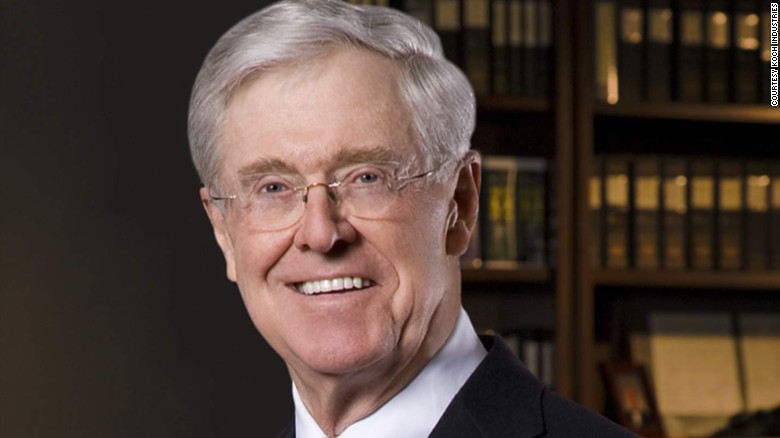
Charles Koch

Charles Koch

Indian Wells, California (CNN)Officials in the influential conservative network affiliated with Charles Koch kicked off their winter summit emphasizing bipartisanship and working to steer clear of fresh confrontation with President Donald Trump.

"Uniting broad coalitions works a lot better than partisan politics," Brian Hooks, a top Koch lieutenant, told reporters Saturday at the start of the three-day retreat. More than 700 people -- including a record 634 donors who contribute at least $100,000 annually to the network -- have descended on a luxury resort here for the gathering.

Leaders in the network, whose size and spending has rivaled the national Republican Party in recent elections, have undergone a significant shift in focus. The network is upping its commitment to work across party lines on top priorities, such as promoting free trade and creating a path to permanent legal status for undocumented immigrants brought to the US as young children.

Koch, the 83-year-old billionaire at the heart of the network, warned that increasing factionalism "is tearing our country apart."

    "We're here to unite people to improve their lives," he said as attendees sipped wine in a vast hotel ballroom during the retreat's opening reception.

    Koch officials did not put a dollar amount on their financial commitment to their 2020 priorities, but the network has spent hundreds of millions of dollars in previous election cycles.

    The gathering marks the first time the donors have come together since a memo to donors leaked in early January indicating that the network would not back Trump's re-election in 2020. Instead, top officials have said they would focus their political muscle on House, Senate and other down-ballot races in 2020.

    The libertarian-leaning network pointedly refused to back Trump ahead of the 2016 election and last summer publicly clashed with the Trump administration over the President's governing style and hardline stances on trade.

    At the time, Hooks warned that the "divisiveness of this White House is causing long-term damage." The criticism prompted a Twitter rebuke from Trump, who called the network a "total joke."

    But as they kicked off their summit Saturday, Koch officials talked less about politics and emphasized their rapidly expanding philanthropic footprint and all the ways they had collaborated with the administration.

    Chief among them: Collaborating with the White House and liberal activists, such as CNN host and commentator Van Jones, last December to help pass the First Step Act, an extensive overhaul of prison and sentencing laws.

    This week, Koch officials attended a White House meeting on immigration, said James Davis, a network spokesman. And Hooks said he was "optimistic" about achieving accord to legally protect the young undocumented immigrants known as DREAMers.

    The donor summit will highlight the network's growing role as a philanthropic clearinghouse for the network's donors, many of them business people who support free-market ideas and donate to community organizations vetted by network officials. A three-year-old arm of the Koch orbit, Stand Together, now supports 118 programs around the country focused on reducing poverty. In January alone, Koch donors helped fund $20 million in grants to such groups, said Evan Feinberg, who runs Stand Together.

    The gathering also will feature presentations from individuals helped by the network's activism.

    Alice Marie Johnson, who was released from prison in Alabama last year after Trump commuted her life sentence for a nonviolent drug offense, was among those slated to address donors over the weekend. She was 63 and had served 21 years in prison when she walked free.

    "I'm living proof that second chances work, because I was given a second chance," Johnson told reporters.

      Although the group is advancing a message of bipartisanship, all three of the elected officials expected to attend the gathering -- Kentucky Gov. Matt Bevin, Nebraska Sen. Ben Sasse and Utah Sen. Mike Lee -- are Republicans.

      The Koch network holds two donor retreats each year -- a winter gathering in Southern California and a summer event in Colorado. Officials open portions of meetings to some journalists but impose restrictions, such as prohibiting reporters from identifying donors without their permission.

      Above is from:  https://www.cnn.com/2019/01/26/politics/koch-network-priorities/index.html

      Who is running Trump policy on Venezuela?


      On Venezuela, Rubio Assumes U.S. Role of Ouster in Chief


      Petare, a slum in Caracas, Venezuela, where violent protests have erupted challenging the legitimacy of Nicolás Maduro’s presidency.CreditCreditMeridith Kohut for The New York Times

      By Peter Baker and Edward Wong

      • Jan. 26, 2019  WASHINGTON — His hand chopping in the air, his voice stern and stalwart, he declared that it was time for the regional despot to go and warned of the consequences if he did not. With a commander in chief’s resolve, he vowed that the United States would do whatever it took to protect its own diplomats on the ground.

      It was not the commander in chief but Senator Marco Rubio, the Florida Republican who nearly three years after losing his own bid for the presidency has become a lead policy architect and de facto spokesman in a daring and risky campaign involving the United States in the unrest that is now gripping Venezuela.

      Through sheer force of will and a concerted effort to engage and educate President Trump, Mr. Rubio has made himself, in effect, a virtual secretary of state for Latin America, driving administration strategy and articulating it to the region from the Senate floor, as he did the other day, and every television camera he can find. Perhaps no other individual outside Venezuela has been more critical in challenging President Nicolás Maduro.

      “He’s picked a battle he can’t win,” Mr. Rubio, 47, said of Mr. Maduro in an interview on Friday. “It’s just a matter of time. The only thing we don’t know is how long it will take — and whether it will be peaceful or bloody.”

      .]

      It was Mr. Rubio who has been whispering in Mr. Trump’s ear since the early days of his presidency about the depravity of Mr. Maduro’s government and the need for American leadership. And it was Mr. Rubio along with Vice President Mike Pence and others who urged the president to back an opposition leader seeking to unseat Mr. Maduro.

      “He has been relentless since Trump’s election, working hard to earn the president’s trust in this policy area,” said former Representative Carlos Curbelo, a fellow Florida Republican. “He owns it and it has clearly paid dividends for him, and more importantly for the victims of Maduro’s tyranny.”


      The senator’s efforts have put the United States in the middle of a roiling confrontation in Caracas that pits Mr. Maduro and Venezuelan military leaders against a popular uprising led by Juan Guaidó, the 35-year-old political activist and industrial engineer who serves as head of the elected National Assembly.

      After Mr. Pence called to pledge Mr. Trump’s support, Mr. Guaidó asserted this past week that he is the interim president under Venezuela’s Constitution because the election last year that kept Mr. Maduro in office was illegitimate. As Mr. Pence promised, the United States followed through by recognizing Mr. Guaidó as the rightful leader, as did about 20 other countries, including Canada, Brazil and Argentina.


      On Saturday, Germany, France and Spain said they would recognize Mr. Guaidó if new elections are not held quickly. At a United Nations Security Council meeting, Alan Duncan, Britain’s representative, called Mr. Guaidó “the right man to take Venezuela forward.” Mr. Rubio chimed in as well to “urge more nations” to join the effort.

      Senator Rubio Press

      @SenRubioPress

      I strongly support @SecPompeo in calling an emergency session on Venezuela at the @UN Security Council to urge more nations to support Venezuela’s return to democratic order and freedom from tyranny.

      Senator Marco Rubio, center, Republican of Florida, has become a chief policy architect and de facto spokesman in a campaign to involve the United States in the unrest that is now gripping Venezuela.CreditMandel Ngan/Agence France-Presse — Getty Images


      Still, Mr. Rubio is well aware of the gamble the United States has taken by pushing for new leadership in Caracas.

      In the interview on Friday, he outlined four possible outcomes to the upheaval: Mr. Maduro could hold onto power; he could be forced out in a palace coup but replaced by a civilian leader just as bad; or he could be unseated by a military installing itself as the new government. Or a popular revolt like the one Mr. Guaidó is currently leading could force change.

      “The U.S. interest is reflected in only one of those outcomes,” Mr. Rubio acknowledged.

      Mr. Rubio’s approach has generated unusually bipartisan support, including from leading Democrats like Senators Richard J. Durbin of Illinois and Robert Menendez of New Jersey. But some veteran government officials and analysts expressed concern that the administration has been too ad hoc: It failed to line up support in advance from the Venezuelan military, which may be critical to Mr. Maduro’s survival. It has given no indication of a clear plan to protect the United States Embassy and its personnel against possible retaliation.

      And while Mr. Rubio insists there are unspecified contingency options that he will not reveal, analysts say the Trump administration does not seem prepared with a Plan B in case Mr. Maduro defies the pressure and holds onto power.

      From more liberal members of Congress comes a more philosophical or ideological objection, a concern that the latest intervention in Latin America evokes a sometimes dark history of Washington meddling in the internal affairs of its neighbors.

      “The United States needs to stay out of Venezuela,” Representative Tulsi Gabbard, a Hawaii Democrat who is running for president, wrote on Twitter. “Let the Venezuelan people determine their future. We don’t want other countries to choose our leaders — so we have to stop trying to choose theirs.”

      Representative Ro Khanna, Democrat of California, bemoaned the influence Mr. Rubio has had on the president. “As a candidate, Trump’s call for greater restraint provided a sharp contrast to Rubio’s foreign policy,” he said by email on Saturday. “But on Venezuela, partly given the domestic politics in Florida, he has deferred to Rubio as a point person for nearly two years.”


      Like other Cuban-American leaders in Florida, Mr. Rubio has long stood against Mr. Maduro and his predecessor, Hugo Chávez, whose socialist governments have been aligned with Havana. He has also been a leading voice pressing the administration to take tough measures against China and Russia, traditional allies of Cuba, as well as other human rights violators.

      Mr. Rubio’s staunch opposition to Mr. Maduro has so gotten under the skin of the hard-liners in Venezuela that a senior official in Caracas reportedly ordered an assassination attempt against the senator in 2017.

      Mr. Maduro at the Miraflores presidential palace this month. Mr. Rubio has long stood against Mr. Maduro and his predecessor, Hugo Chávez, whose leftist governments have been aligned with Cuba.Creditvia Reuters

      Image


      Mr. Rubio responded with bravado. After Secretary of State Mike Pompeo imposed sanctions last year on Diosdado Cabello Rondón, the vice president of the ruling United Socialist Party who was said to have ordered the hit, the senator taunted the Venezuelan on Twitter by posting a photograph of prisoners in orange jumpsuits, suggesting he could wind up behind bars.

      “What size uniform do you wear these days extra large or XX-large?” Mr. Rubio wrote. “Just want to make sure your stay is as comfortable as possible.”

      Mr. Rubio understands that after years of misadventures overseas, many Americans are reluctant to take on yet another foreign dictatorship. “Why should it matter to us?” he asked on the Senate floor on Thursday. “Why should America even be involved in this?”

      He went on to describe the “sheer repression” and corruption of Mr. Maduro’s government that has driven his oil-rich country into the depths of economic despair, prompting three million Venezuelans to flee.

      Mr. Rubio’s real target, though, has been an audience of one, a man who in the throes of their battle for the Republican nomination in 2016 derided him as “Little Marco.”

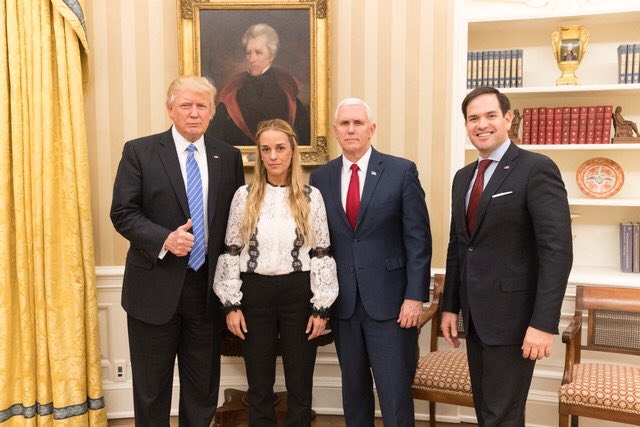
      He waited less than a month after Mr. Trump took office to begin a persistent effort to draw the president’s attention to Venezuela. In February 2017, Mr. Rubio along with Mr. Pence helped usher Lilian Tintori, a Venezuelan political activist and television star, into the Oval Office to meet Mr. Trump. She told the president about her husband, Leopoldo López, an opposition leader under house arrest.

      Mr. Trump later tweeted a photo of himself giving a thumbs up next to Ms. Tintori, with Mr. Rubio and Mr. Pence on her other side. In the tweet, the president called on Venezuela to release her husband immediately.

      View image on Twitter

      View image on Twitter

      Donald J. Trump

      @realDonaldTrump

      Venezuela should allow Leopoldo Lopez, a political prisoner & husband of @liliantintori (just met w/ @marcorubio) out of prison immediately.


      “The president really responds to the human side of issues,” Mr. Rubio said on Friday. “If you can humanize it or personalize it, that’s important. When he met her and was able to hear her, it made an impression on him.”

      Since then, Mr. Rubio said he has spoken with Mr. Trump about Venezuela at least once a month. Mr. Pence has long seen the issue similarly and the two gained allies with the arrival of Mr. Pompeo and John R. Bolton, the national security adviser.

      Juan Guaidó, 35, a political activist, speaking on Friday. Mr. Guaidó has asserted that he is the interim president under Venezuela’s Constitution.CreditMeridith Kohut for The New York Times


      Image

      Juan Guaidó, 35, a political activist, speaking on Friday. Mr. Guaidó has asserted that he is the interim president under Venezuela’s Constitution.CreditMeridith Kohut for The New York Times

      Mr. Rubio also helped place another Cuban-American political figure from Florida, Mauricio Claver-Carone, as senior director for Western Hemisphere affairs at the National Security Council. “Once Mauricio went in, the policy went on hyperdrive,” Mr. Rubio said. “He’s aware of these issues.”

      Still, some involved in the issue said Mr. Rubio’s sway has been overstated and that, as important as he has been, Mr. Trump needed little persuasion. When Mr. Guaidó was briefly arrested and then released this month after first broaching the idea of taking over as interim president, Mr. Pence called the opposition leader to convey the president’s support.

      Last Tuesday, the day before mass protests against Mr. Maduro, Mr. Trump met with Mr. Pence and Mr. Bolton. The vice president presented a memo with options and encouraged Mr. Trump to formally recognize Mr. Guaidó as the country’s leader if he did claim power, according to a White House official. The president agreed.

      Later that day, Mr. Trump and his team met with Mr. Rubio at the White House along with three other Florida Republicans: Gov. Ron DeSantis, Senator Rick Scott and Representative Mario Diaz-Balart. Mr. Rubio likewise embraced the idea of recognizing Mr. Guaidó.

      Mr. Pence called Mr. Guaidó afterward and told him that the United States would support him if he claimed the presidency. The vice president uploaded a video addressing the Venezuelan people and encouraged protesters. The next day, Mr. Guaidó asserted his leadership and Mr. Trump backed him.

      Mr. Rubio speaks in vague terms about his ties with Mr. Guaidó. He cannot recall how many times the two men have met; unlike Ms. Tintori, Mr. Guaidó has not been a prominent opposition figure who traveled abroad often. “A year and a half ago, he wouldn’t have been a name you would have heard of,” Mr. Rubio said. “I don’t think this was an ambition of his.”

      Nor was his name high on the list at the State Department. As recently as this month, when aides to Representative Jim Himes, Democrat of Connecticut, spoke with department officials about the agency supporting Mr. Guaidó if he claimed the title of interim president, they were met with resistance.

      “We were cautioned by State not to inflame a volatile situation,” Mr. Himes said in an interview.

      Mr. Rubio has also pressed the administration to increase aid to Venezuelans, who have suffered for years from an imploding economy. Mr. Pompeo on Thursday announced $20 million in food and medical aid for Venezuelans.

      But the real worry in Washington is if the situation in Caracas takes a violent turn. Mr. Rubio has talked with administration officials about options if it does — and speaks with authority as if he were the decider.

      “If Maduro turns violent, whether it’s against Guaidó or the assembly or the people or, God forbid, our embassy, the consequences will be swift and severe,” he said. “I can tell you for a fact that it won’t be a letter of condemnation.”

      At least not if he has anything to say about it.

      Adam Goldman contributed reporting from Washington, and Megan Specia from New York.

      Follow Peter Baker and Edward Wong on Twitter: @peterbakernyt and @ewong.

      Above is from: https://www.nytimes.com/2019/01/26/world/americas/marco-rubio-venezuela.html

      Saturday, January 26, 2019

      Sheriff needs more money?


      Boone County Sheriff faces staff cuts, revenue shortage


      BOONE COUNTY (WREX) – The Boone County Sheriff’s Office is facing a crisis. It says its running on bare bones and losing around half a million dollars in revenue this year.

      “Quite frankly, I have to draw a line in the sand,” Sheriff Dave Ernest said. “We cannot go below our staffing levels right now. This is a bare minimum. We have cut to the max.”

      For the past several years, the Boone County jail helped house DeKalb County inmates for annual fees of around $300,000 to $500,000. But now the DeKalb County jail is open and that revenue stream is gone. That means Boone County has to make up the difference.

      “We lost another deputy this budget period, we lost another corrections officer this budget period which obviously doesn’t help our staffing levels,” Ernest said.

      But board members say even those cuts might not be enough.

      “It’s kind of a waiting game to understand what that new economic situation is for us,” Boone County Board Chairman Karl Johnson said.

      For Johnson that means keeping a close eye on opportunities for new revenue — or *possibly making more cuts.

      If we’re going to make reductions, we’d prefer to make those reductions at the corrections facility rather than deputies on the street,” Johnson said. “I think deputies on the street correlates directly to the potential safety of our citizens and keeping crime out of the area.”

      Although with staff-levels low at both the sheriff’s office and the jail, the county is also juggling rising overtime costs.

      “We had close to $350,000 dollars in overtime last year, which is ridiculous for a jail our size,” Ernest said.

      With costs piling up and cash running out, Boone County needs a solution to this problem that only threatens to get worse.

      The public safety budget makes up more than half of Boone County’s $17 million budget.

      Above is from: https://wrex.com/category/2019/01/23/boone-county-sheriff-faces-staff-cuts-revenue-shortage/

      Monday, January 21, 2019

      Women’s march in Rockford hosts diverse group of speakers but smaller crowd

      Women’s march in Rockford hosts diverse group of speakers but smaller crowd

      By Kristen Zambo
      Staff writer

      Posted Jan 19, 2019 at 5:25 PMUpdated Jan 19, 2019 at 5:28 PM

      ROCKFORD — Subzero wind chills and the hefty snowfall in the Rockford region resulted in a fraction of the turnout for Saturday’s Women’s March Rockford compared with the attendees the event has drawn during the two previous years, organizers said.

      Chanting “women’s rights are human rights,” fewer than 300 people braved frigid temperatures to attend the noon march after a winter storm swept through the region Friday and into Saturday morning. An estimated 1,500 people attended last year’s Rockford march, up slightly from the more than 1,000 people who attended the inaugural march in 2017.

      Monitors with the National Weather Service reported that 6.5 to 7.6 inches of snow fell on different portions of Rockford by 7 a.m. Saturday. Gusty winds throughout the day and plummeting temperatures created hazardous weather conditions, according to the weather service. Saturday’s high in Rockford was forecast for 16 degrees, but with the wind chill, it is felt like minus -9 degrees.

      Organizers initially thought Rockford’s march would attract a larger crowd because Chicago’s march was canceled because of budget restrictions. That came on the heels of backlash against the national Women’s March organization amid allegations of anti-Semitism. During an event last year in Chicago, Nation of Islam leader Louis Farrakhan made comments about “powerful Jews” being his enemies and four of the national Women’s March organization’s co-chairs have ties to Farrakhan.


      Organizers of the Rockford march took steps to distance themselves from the national organization and “made it clear we were including everybody,” said Ronit Golan, past president of the Jewish Federation of Greater Rockford. “I think we have to be welcoming to those diverse populations and I think this is a great start.”

      With a little more than 270 people in attendance, the crowd still largely was comprised of white faces.

      “To me it’s not a brown or black issue. It’s Woman’s Day,” said Leslie West, 42, of Rockford, who is black. “It’s important for everybody to come out. We have to exercise our voices.”

      Above is from:  https://www.rrstar.com/news/20190119/womens-march-in-rockford-hosts-diverse-group-of-speakers-but-smaller-crowd