Wednesday, August 1, 2018

Time to bring congressman’s tenure to an end


image

By Sharon McLane Grand Detour

July 30, 2018

Who is Adam Kinzinger’s boss? You are!

You pay his $174,000 salary. You have sent him to Washington, D.C., the past 6 years to represent your interests. Yet, he feels no obligation to meet you in a public forum where you can ask questions that are of interest to you.

Imagine telling your boss that you have no interest in hearing his opinions or thoughts about how you are doing your job!

Have you sent Rep. Kinzinger a letter or email? Have you posted on his Facebook page about an issue that concerns you? Then you have received the same impersonal form letter response that I have! Clearly, he thinks he knows better than you, his boss, how to do his job.

You don’t have to put up with being represented in Congress by someone who has no interest in knowing who his boss is. You don’t have to put up with a representative who doesn’t represent you, or who takes his orders from people who have probably never been to the Sauk Valley! 

Please give Kinzinger a serious performance review. You can terminate him for failure to perform on Nov. 6! I encourage you to do so.

Above is from:: http://www.saukvalley.com/2018/07/19/time-to-bring-congressmans-tenure-to-an-end/axvvbt4/

Sunday, July 29, 2018

Why haven't all the families been reunited? Cruelty, pure and simple


image

Why haven't all the families been reunited? Cruelty, pure and simple

By Brian Schatz

Jul 27, 2018 | 3:00 AM

Why haven't all the families been reunited? Cruelty, pure and simple

Shoes and toys left by migrants at the Tornillo Port of Entry in Tornillo, Texas. (Brendan Smialowski/ AFP/Getty Images)

The failure of the U.S. government to reverse the kidnapping of thousands of children from their parents has been chalked up to incompetence. People want to believe that this act of extraordinary cruelty — and the Trump administration’s inability to fix it — stems from our leaders’ lack of experience or common sense.

But this too is a failure — of our collective imagination. The separation of children from their parents at the Southwest border is not simply a policy that has resulted in immeasurable harm, but a policy designed to inflict it. The government blew its Thursday deadline to reunite these families because it never intended to do so.


How else can we explain what has happened to these families? Some 14 million checked bags are managed by the Transportation Security Administration — and that’s just during Thanksgiving weekend. Even high school students can manage a coat check for an evening without losing everyone’s coats. They match each coat and owner with corresponding tickets, and do not store the coats outside the building, or even thousands of miles away from the event.

This administration will harm children in order to force Congress to agree to its absurd immigration policies.


The administration did not take even these basic measures when it began to separate children — not coats! — from their parents. It did not use corresponding numbers for the files of parents and children, or take photos of families together, or hand out hospital-style bracelets. It did not house families near one another, choosing instead to hold mothers in California and daughters in Chicago, fathers in Texas and sons in New York City.

In fact, the administration seems to have taken a comprehensive inventory of confiscated items — sneakers, toothpaste, rosaries — everything except which child belongs to which parent.

These are the actions of a government that intended to separate families but did not intend to reunite them. It meant to inflict so much suffering that other families wouldn’t make the dangerous trek. No matter how bad the violence might be in Central America, surely these families would choose to stay united rather than come and be separated.

In fact, through all the blather, the Trump administration has admitted as much.

“I would do almost anything to deter the people from Central America,” White House Chief of Staff John F. Kelly said in 2017. Even separate children from their parents, asked CNN’s Wolf Blitzer? “Yes.”

“We expect that the new policy will result in a deterrence effect,” Health and Human Services Assistant Secretary Steven Wagner told reporters in June.

“Hopefully people will get the message,” Atty. Gen. Jeff Sessions said casually on Fox News in June.

But according to the Department of Homeland Security, no one has been deterred. The number of families stopped at the border actually increased by 64% in the months after the administration began to separate families. So even if you could stomach traumatizing toddlers, this policy did not accomplish Sessions’ objective of sending a warning across the desert.

Still, cruelty has its uses. Across the country, Republicans have made the Trump administration’s immigration stance their rallying cry for reelection, running more than 14,000 campaign ads this year bragging about their efforts to “stop illegals.” And last month, Sessions spelled out the administration’s plan to use all the bad press for good.

“We do not want to separate parents from their children,” he clarified. “If we build the wall, if we pass legislation to end the lawlessness, we won’t face these terrible choices.”

In other words, this administration will harm children in order to force Congress to agree to its absurd immigration policies. But let’s be clear: No lawmaker of any party should ever accede to a legislative demand in response to the intentional infliction of harm.


The American people must also speak up. Our government has kidnapped children from their parents. It forces these lost boys and girls to say the Pledge of Allegiance while they are held captive in building wings named for U.S. presidents. (It is not hard to believe that President Reagan would be aghast.)

This is not who we are, we want to say, but that isn’t quite true. This policy reveals a darker side of America that has dehumanized black and brown people since our nation’s founding. Americans have stolen and enslaved black people, killed indigenous peoples and imprisoned Japanese Americans. The reason why this administration has pumped out racist rhetoric casting people as fish to be caught, infestations to be eradicated, and animals to be caged is because it has worked before.

Will it work again? That’s up to us.

Brian Schatz represents Hawaii in the U.S. Senate.

Above is from:  http://www.latimes.com/opinion/op-ed/la-oe-schatz-family-reunification-20180727-story.html#nws=mcnewsletter

Brian Schatz

United States Senator

Image result for brian schatz

<?XML:NAMESPACE PREFIX = "[default] http://www.w3.org/2000/svg" NS = "http://www.w3.org/2000/svg" />schatz.senate.gov

Brian Emanuel Schatz is an American politician serving as the senior United States Senator from Hawaii since 2012. Schatz was appointed by Governor Neil Abercrombie to replace Senator Daniel Inouye after his death. Wikipedia

Born: October 20, 1972 (age 45 years), Ann Arbor, MI

Spouse: Linda Kwok

Office: Senator (D-HI) since 2012

Previous office: Lieutenant Governor of Hawaii (2010–2012)

Education: Pomona College

Current position: United States Senator

How Did the End of the World Become Old News?

July 26, 2018 9:40 am

How Did the End of the World Become Old News?

By David Wallace-Wells
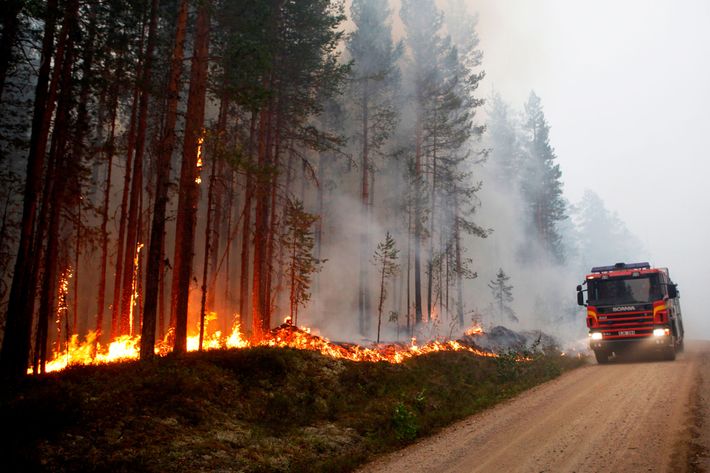
The fire this time (in Sweden). Photo: Mats Andersson/AFP/Getty Images

There has been a lot of burning lately. Last week, wildfires broke out in the Arctic Circle, where temperatures reached almost 90 degrees; they are still roiling northern Sweden, 21 of them. And this week, wildfires swept through the Greek seaside, outside Athens, killing at least 80 and hospitalizing almost 200. At one resort, dozens of guests tried to escape the flames by descending a narrow stone staircase into the Aegean, only to be engulfed along the way, dying literally in each other’s arms.

Last July, I wrote a much-talked-over magazine cover story considering the worst-case scenarios for climate change — much talked over, in part, because it was so terrifying, which made some of the scenarios a bit hard to believe. Those worst-case scenarios are still quite unlikely, since they require both that we do nothing to alter our emissions path, which is still arcing upward, and that those unabated emissions bring us to climate outcomes on the far end of what’s possible by 2100.

But, this July, we already seem much farther along on those paths than even the most alarmist climate observers — e.g., me — would have predicted a year ago. In a single week earlier this month, dozens of places around the world were hit with record temperatures in what was, effectively, an unprecedented, planet-encompassing heat wave: from Denver to Burlington to Ottawa; from Glasgow to Shannon to Belfast; from Tbilisi, in Georgia, and Yerevan, in Armenia, to whole swaths of southern Russia. The temperature of one city in Oman, where the daytime highs had reached 122 degrees Fahrenheit, did not drop below 108 all night; in Montreal, Canada, 50 died from the heat. That same week, 30 major wildfires burned in the American West, including one, in California, that grew at the rate of 10,000 football fields each hour, and another, in Colorado, that produced a volcano-like 300-foot eruption of flames, swallowing an entire subdivision and inventing a new term — “fire tsunami” — along the way. On the other side of the planet, biblical rains flooded Japan, where 1.2 million were evacuated from their homes. The following week, the heat struck there, killing dozens. The following week.

In other words, it has been a month of historic, even unprecedented, climate horrors. But you may not have noticed, if you are anything but the most discriminating consumer of news. The major networks aired 127 segments on the unprecedented July heat wave, Media Matters usefully tabulated, and only one so much as mentioned climate change. The New York Times has done admirable work on global warming over the last year, launching a new climate desk and devoting tremendous resources to high-production-value special climate “features.” But even their original story on the wildfires in Greece made no mention of climate change — after some criticism on Twitter, they added a reference.

Over the last few days, there has been a flurry of chatter among climate writers and climate scientists, and the climate-curious who follow them, about this failure. In perhaps the most widely parsed and debated Twitter exchange, MSNBC’s Chris Hayes — whose show, All In, has distinguished itself with the seriousness of its climate coverage — described the dilemma facing every well-intentioned person in his spot: the transformation of the planet and the degradation may be the biggest and most important story of our time, indeed of all time, but on television, at least, it has nevertheless proven, so far, a “palpable ratings killer.” All of which raises a very dispiriting possibility, considering the scale of the climate crisis: Has the end of the world as we know it become, already, old news?

If so, that would be really, really bad. As I’ve written before, and as Wen Stephenson echoed more recently in The Baffler, climate change is not a matter of “yes” or “no,” not a binary process where we end up either “fucked” or “not fucked.” It is a system that gets worse over time as long as we continue to emit greenhouse gases. We are just beginning to see the horrors that climate change has in store for us —but that does not mean that the story is settled. Things will get worse, almost certainly much, much worse. Indeed, the news about what more to expect, coming out of new research, only darkens our picture of what to expect: Just over the past few weeks, new studies have suggested heat in many major Indian cities would be literally lethal by century’s end, if current warming trends continue, and that, by that time, global economic output could fall, thanks to climate effects, by 30 percent or more. That is an impact twice as deep as the global Great Depression, and it would not be temporary.

These are not the kinds of findings it is easy to ignore, or dismiss, or compartmentalize, even though we have all become exquisitely skilled lately in compartmentalizing the threat. Neither is it easy to forget the stories of the Greek wildfires, or the Japanese heat wave. Which is why it is perhaps important to remember that the media did not ignore these stories, or the month of global climate horrors that gave rise to them. Television networks covered those heat waves 127 times. That is, actually, a very lot! They just utterly failed to “connect the dots,” as Emily Atkin put it incisively at The New Republic —broadcasters told the story of the historic temperatures, but chose not to touch the question of why we were seeing so many of them, all at once, with the atmosphere more full of carbon, and the planet hotter, than it has ever been at any point in human history.

When you think about it, this would be a very strange choice for a producer or an editor concerned about boring or losing his or her audience — it would mean leaving aside the far more dramatic story of the total transformation of the planet’s climate system, and the immediate and all-encompassing threat posed by climate change to the way we live on Earth, to tell the pretty mundane story of some really hot days in the region.

Which is why this all sounds to me a lot more like self-censorship than ratings-chasing — by which I mean self-censorship of two kinds. The first is the intuitive one — the kind done in anticipation of political blowback, an especially acute problem for would-be neutral, would-be centrist platforms like network news. This self-censorship in fear of right-wing backlash is a familiar story, and most of those concerned about global warming know the villains already: oil companies, climate deniers, indifferent (at best) politicians, and constituents who see science as a culture-war front.

But public apathy, and its cousin climate complacency, is as big a problem — perhaps bigger. And this problem, too, is connected to self-censorship on the part of storytellers who feel intimidated from attributing what we used to know as natural disasters to global warming because scientists are so excruciatingly careful about attributing cause. As NPR’s science editor Geoff Brumfiel told Atkin, “You don’t just want to be throwing around, ‘This is due to climate change, that is due to climate change.’”

Well — why not? The stated reason, when a reason is stated, is that scientists can take years to definitively conclude that a particular disaster was impossible without the effects of warming, and often only speak with certainty about specific events a decade or more in the past— the 2003 European heat wave, for instance, which killed tens of thousands. But wildfires are “not caused by climate change” only in the same way that hurricanes are not caused by climate change — which is to say they are (only) made more likely by it, which is to say the distinction is semantic. The same is true, even more so, for heat waves: We know global warming will cause many more deadly temperatures, and should not be confused, at all, when we suddenly encounter an unprecedented number of them. The fact that most climate scientists would say something like, “These disasters are consistent with what we would expect, given global warming,” rather than “these disasters were caused by global warming” is not a reason to elide discussion of climate change. Doing so is an evasion, even if it is made with a scientific alibi.

It is also a dangerous one. Decades of bad-faith debates about whether climate change is “real” and good-faith questions about whether it is “here” have dramatically foreshortened our collective imagination and provided an unfortunately limited picture of what global warming will yield. Treating every climate disaster as a discrete event only compounds the problem, suggesting that impacts will be discrete. They won’t be, and the longer-view story is much more harrowing: not just more months like July, but an unfolding century when a month like this July has become a happy memory of a placid climate. That it is almost hard to believe only makes it a more important story to tell.

Above is from:  http://nymag.com/daily/intelligencer/amp/2018/07/climate-change-wildfires-heatwave-media-old-news-end-of-the-world.html?__twitter_impression=true

Friday, July 27, 2018

How China's tariffs on soybeans fueled the US GDP bump

Soybeans are a weak spot in President Donald Trump’s trade war with China as the country has imposed retaliatory tariffs to hit his voter base — American farmers. To defend against these tariffs, Trump has offered a short-term assistance of $12 billion to producers of soybeans, sorghum and other crops.

But on Friday, soybean tariffs may have actually given Trump a boost. They contributed to the robust GDP growth that the president touted — “We’ve accomplished an economic turnaround of historic proportions,” he said.

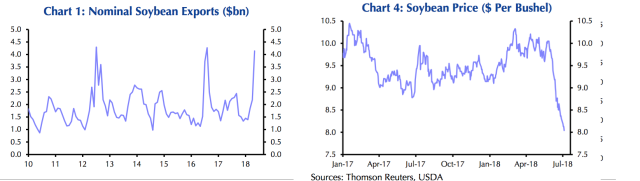
The U.S. economy grew 4.1% in the second quarter, partly due to a burst in soybean and corn exports, according to economists. In May, the latest data available, soybean exports nearly doubled compared to in April. Producers were in a rush to beat tit-for-tat sanctions, soybean exports are up 26% for the year compared to 2017.

The burst in soybean export has sent quarter GDP growth higher. (Screenshot/Capital Economics)
In the second quarter, the U.S. recorded an 80% annualized jump in food, feed and beverage exports, mainly from soybeans and corn. Without that surge, exports would have increased 5.3% instead of 9.3%, which means the GDP growth would have been around 3.6%, according to Paul Ashworth, the chief U.S. economist at Capital Economics.

David Rosenberg, the chief economist of Gluskin Sheff, argues trade disputes may play an even bigger role in inflating GDP. “At least half the growth is coming from two trade-related issues — a soybean-led export burst and inventory accumulation. Net these out and we remain near 2%”, he tweeted on Thursday.

How sustainable could the growth be?

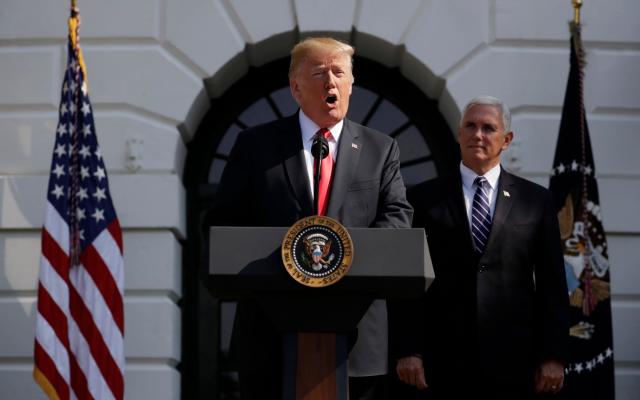
President Trump speaks in White House after the second quarter GDP number is released. (Credit: The Telegraph)

Trump seized the opportunity to boast about the strong economic results. “These numbers are very, very sustainable— this isn’t a one-time shot,” he said during a White House press conference on Friday.

But economists caution that the growth rate is hard to maintain. This is not the first time that soybeans have fueled a short-term bump in GDP. Back in mid-2016, U.S exporters experienced a boom when the Brazilian crop disappointed. The impact on nominal export growth was drastic — it hit 10% annualized growth in August, but fell to near-zero in December. Excluding soybeans and corn, the export growth was steady at around 5% in the second half of 2016.

Ashworth doesn’t expect this time to be different. He projects soybean exports to plummet in July, dragging nominal exports down by 1.8% compared with June, and the GPD number will be back to normal — at about 2.6% in the third quarter.

The trade truce between the U.S. and EU earlier this week doesn’t change his view. “In the global soybean market, the demand and supply are roughly balanced,” Ashworth told Yahoo Finance. He thinks the U.S. will end up exporting to a different country rather than China to mitigate the impact of the tariffs. “If you’re looking at the year as a whole, it doesn’t have any impact at all,” he said. “It just has an impact in one quarter and will be reversed in the next.”

Krystal Hu covers technology and economy for Yahoo Finance. Follow her on Twitter.

Above is from:  https://www.yahoo.com/finance/news/chinas-tariffs-soybeans-fueled-us-gdp-bump-225326578.html

Thursday, July 26, 2018

Why Trump supporters never waver


Rick Newman 7 hours ago


  • Different president. But it’s still the economy, stupid.

Critics of President Trump seemed dumbfounded by his steady approval rating, which, while low, also seems impervious to scandal, lying, poor policymaking and outrageous behavior.

Trump’s approval rating stands at 42%, according to Gallup, which tracks Americans’ views of the president weekly. Trump’s high for the year was 45% in mid-June, and the low was 36% in late January. So he has generally drifted upward this year. Here’s the trend:

Source: Gallup

This shouldn’t be happening, some analysts believe. Trump has enraged critics during the last few months by pandering to Russian dictator Vladimir Putin, hurting American farmers with protectionist trade policies, breaking up migrant families at the southern border, and lying on a daily basis. His personal scandals seem to be deepening, as former fixer Michael Cohen turns on him and the Mueller investigation widens.

So why do Trump’s supporters stick with him? Three basic reasons: They don’t pay close attention to policy issues the way Washington eggheads and media elites do. Trump continues to deliver on key issues they care about, such as immigration. And perhaps most important: the economy is strong.

“Trump has offended immense numbers of people,” says Emily Ekins, director of polling at the libertarian Cato Institute, who has published a detailed analysis of Trump voters. “But most people aren’t paying as close attention as the people in New York and D.C. whose job is to follow these issues. And the economy is hugely important to understanding voter choice.”

There’s good and bad news for Trump in the stability of his support. He does seem to have a core set of voters who will back him even if he shoots somebody on Fifth Avenue. That may provide a floor of 30% or so to his approval rating, meaning he wouldn’t slip below that under any circumstance.

But the additional support—in the range of 12% to 15%—isn’t as solid, and could waver if the economy weakens. It’s also notable that Trump’s approval rating isn’t higher, given strong growth and a very low unemployment rate of 4%. The last time unemployment was that low was in 2000, when Bill Clinton’s approval rating hovered around 60% – and that was after the House of Representatives impeached Clinton for lying about an affair with White House intern Monica Lewinsky.

In a study for the Democracy Fund Voter Study Group, a privately funded research outfit, Ekins identified five types of Trump voters and assessed how important each group was to Trump’s victory. The breakdown helps explain why Trump’s supporters stick with him, no matter how controversial he is. It also reveals Trump’s weaknesses, which are considerable. Here’s an overview:

Source: Democracy Fund Voter Study Group

Staunch conservatives and American preservationists are Trump’s true base, representing about half of those who voted for him. They tend to be America-first nativists who are socially conservative and opposed to immigration, and may feel culturally threatened. Trump’s hard-line immigration policy is meant for them, and they’ll probably stick with him no matter what.

The disengaged, a small portion of Trump voters, aren’t very knowledgeable about politics, but they do tend to feel powerless and left behind in the modern economy. Trump’s vilification of immigrants and Muslims may appeal to them and earn their loyalty.

Free marketeers and anti-elites are more moderate. They tend to be traditional Republicans who may have voted for Trump simply out of party loyalty. They support free trade and a light government touch on the economy, which is at odds with Trump’s interventionist trade policy. Some of these people already regret voting for Trump, and he could lose more if his protectionist trade policy backfires or the economy weakens. Since these two groups represent about 45% of Trump voters, his approval rating could fall into the mid or low 30s if the economy begins to struggle, which would weaken Trump’s political power and his leverage over fellow Republicans in Congress. This is his biggest vulnerability.

Bill Clinton’s campaign team realized it’s the economy, stupid, back in 1992, which helped the young governor beat George H. W. Bush in that year’s presidential campaign. Some analysts think that logic doesn’t apply to Trump, as if every Trump supporter today would still be with him if companies were slashing jobs and the stock market were in a free fall. But Trump is just as tied to the economy as any other president, and his relatively weak approval in boom times may make Trump even more vulnerable to a downturn.

“He has underperformed, given the economic fundamentals,” Ekins says. “It shows what being offensive can do to a candidate.” It may show even more if those fundamentals weaken.

Confidential tip line: rickjnewman@yahoo.com. Click here to get Rick’s stories by email.

Above is from:: https://www.yahoo.com/finance/news/trump-supporters-never-waver-185256151.html

Wednesday, July 25, 2018

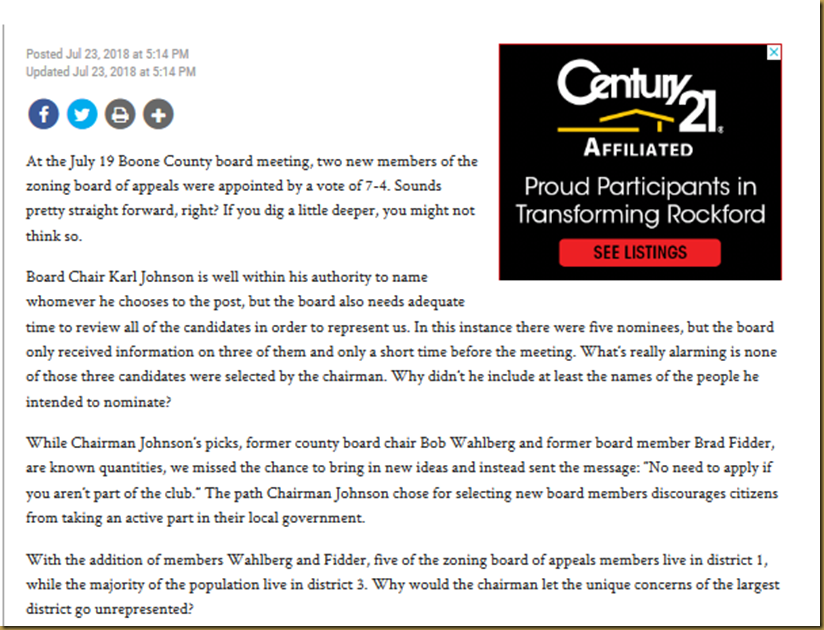
How representative are Boone County’s various boards?


image


image

image


Above is from:  http://www.rrstar.com/opinion/20180723/letter-boone-county-board-needs-to-be-more-representative


Facebook © 2018

Cathy Ward 

Yesterday (7/26/2018) at 9:41 AM ·

BOONE COUNTY BOARD NOTES - Decisions made by county board members CAN BE reversed. Here is how it can work, for example. Last week, the board voted 7-4 to approve the appointments for the Zoning Board of Appeals recommended by board chair Karl Johnson. Those appointments were former board chair Bob Walberg and former board member Brad Fidder. Those appointments were questioned for many reasons. Now to reverse that, at the next meeting, any of the seven who voted for Walberg and Fidder can ask that those appointments be reconsidered. Then the board can vote again on whether to approve the appointments. Those voting for the appointments were Sherry Giesecke, Denny Ellingson, Marshall Newhouse, Jeff Carlisle, Bernard O'Malley, Carl Larson and Karl Johnson. If you like those appointments, you can call any of those seven and thank them. If you would like those appointments to be reconsidered, you can call any of the seven and ask them to make the motion to reconsider. Those of us opposed were Brad Stark, Sherry Branson, Jessica Muellner and me. You
can also call and thank us for voting no or tell us those appointments were in the best interest of the county. Love to hear from you on either side of any issue.

image

Tuesday, July 24, 2018

NO—Yes—NO—YES but benefiting Democrats

President Donald Trump said Tuesday he's "very concerned" that Russia will attempt to meddle in the upcoming midterm elections to the benefit of the Democrats because he says he's been so tough on Russia.

The expression of concern about Russian meddling is a change in tone for the president, who has repeatedly expressed doubts about Russia's role in interfering in the 2016 U.S. election.

As recently as Sunday night, President Trump again referred to the concept of Russian election meddling as a “big hoax.” White House press secretary Sarah Sanders has since sought to argue that the president was only “referring to the claim that his campaign had anything to do with it.”

Standing next to Russian President Vladimir Putin last Monday, President Trump said he had “confidence in both parties,” referring to the U.S. and Russia.

“President Putin, he just said it’s not Russia. I will say this: I don’t see any reason why it would be,” the president said last Monday.

PHOTO: President Donald Trump, left, and Russian President Vladimir Putin, right, shake hands at the beginning of a meeting at the Presidential Palace in Helsinki, Finland, July 16, 2018. (Pablo Martinez Monsivais/AP, FILE)

Then on Tuesday, Trump issued a rare clarification and said he misspoke.

"In a key sentence in my remarks I said the word would instead of wouldn't, the sentence should have been, ‘I don't see any reason why it wouldn't,’ or why it wouldn't be Russia,” he said.

The president's expression of concern for future meddling also stands in contrast to previous comments.

Just last week,the president twice said "no" when ABC News' Cecilia Vega asked if he believed Russia was still targeting the U.S. Such as response would seem to contradict the president's Director of National Intelligence Dan Coats who had recently warned that "the warning lights are blinking red again" when it came to the threat of Russian cyber attacks.

The White House later said the president was saying "no" to taking reporters' questions and was not answering Vega's question.

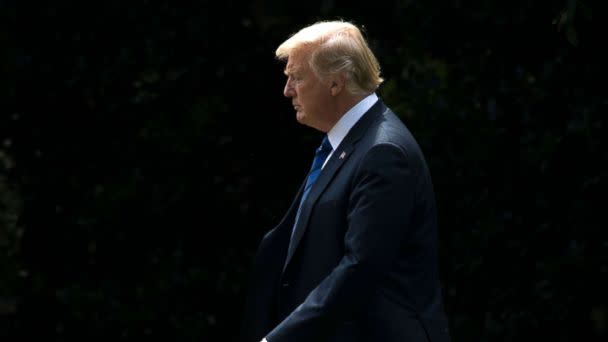
PHOTO: President Donald Trump departs the White House, July 20, 2018. (Michael Reynolds/EPA via Shutterstock, file)

There is currently no publicly available evidence to support the president's claim that the Kremlin is interested in helping Democrats in the fall election.

In Helsinki last week, Putin said he did want Trump to win the election because Trump had "talked about bringing the U.S.-Russia relationship back to normal."

Democratic Leader Sen. Chuck Schumer seized on Putin's past comment as a counter-point to the president's tweet, blasting out the video clip with the caption "let's go to the videotape (again)."

Above is from:  https://www.yahoo.com/gma/president-trump-says-hes-very-concerned-russia-meddle-190803034--abc-news-topstories.html