Friday, April 20, 2018

Belvidere “alley” issue fails because of Mayor’s veto

Local News

Belvidere city council members argue over neighborhood alley improvement

By: Gregory Cormier

Updated: Apr 16, 2018 11:00 PM CDT


BELVIDERE - "It's a safety issue being that there's going to be a paved alley with people driving 25 miles an hour, 8 feet from my house," said Belvidere resident Scott Cregreen. He worries about what will happen if the city improves an alley in his neighborhood.

The alley between East 8th and 9th Streets has been a topic of controversy recently. City council members have tried more than once over the last few years to approve paving it.

"Something like this to me is just pretty ludicrous, we don't have the money," said Belvidere Mayor Mike Chamberlain. "It's been discussed multiple times, I have a problem with the ethics of who brought it and who voted," he added.

Chamberlain vetoed the council's vote to pave the alley earlier this month. He says one alderman would personally benefit from the improvement. City council members could not get enough votes to override the veto.

"It passed with a super majority when we voted on it, it passed with a majority in 2012, moving forward I don't know what the next course of action will be," said Belvidere Alderman Marcia Freeman. Freeman lives near the alley and argues having it paved would have made it easier for homeowners to get to their backyards and help police and fire respond.

"My neighbors and the people I represent want their access back," said Freeman. "It's not that they are asking for an alley that doesn't exist, they're asking for their access back," she added. Chamberlain argues spending the 12,000 dollars for the project would take away from future investment in roads everyone in the city uses.

"We need to spend as much money as we can put in our budget every year in improving the streets that are used all day everyday," he said.

Above is fromhttp://www.mystateline.com/news/local-news/belvidere-city-council-members-argue-over-neighborhood-alley-improvement/1126612358

Boone County Fair receives state money

Posted: Apr 19, 2018 6:46 PM CDT

BOONE COUNTY (WREX) -

After waiting for nearly $85,000 in state funding since November 2017, Illinois Comptroller's office told 13 News that they have been approved to release all fair funding immediately.

The Boone County Fair says through the Department of Agriculture, they had applied for funding. However, after speaking to the Comptroller's office, they said the Department of Agriculture applied for over $11 Million in voucher requests, but they only have $4.4 Million to allocate. The fair funding made the priority list and was just granted the funds it applied for.

Boone County board member, Jack Ratcliffe says if these funds didn't come soon, they would not have been able to make the necessary improvements they had planned on making for this years fair.

"All of our maintenance we need to do.. needs to be done by July, so we need the operating capital as soon as possible," Ratcliffe said.

Ratcliffe says they were able to avoid possible setbacks, like having to increase gate prices, or even cutting prize premiums thanks to the recent news of their funding going through.

Illinois State Senator, Dave Syverson says this funding is extremely important to the community, and to all the fairs around the state as well.

"It is a strong economic engine and has a rich history. The people who run the Boone County Fair have consistently been at the top in the state when it comes to managing great family fun," Syverson said.

The Boone County fair will take place at the Boone County Fair grounds from August 7 through 12.

Above is from:  http://www.wrex.com/story/37999660/2018/04/Thursday/boone-county-fair-receives-long-awaited-state-funding

Thursday, April 19, 2018

Political killings shake Mexico election

April 18, 2018 / 12:07 AM / Updated 9 hours ago

'We are watching you': Political killings shake Mexico election

Lizbeth Diaz


CIUDAD JUAREZ, Mexico (Reuters) - Magda Rubio had just launched her campaign for mayor of a small city in northern Mexico, when a chilling voice came through her cell phone. “Drop out,” the caller warned, “or be killed.”

<?XML:NAMESPACE PREFIX = "[default] http://www.w3.org/2000/svg" NS = "http://www.w3.org/2000/svg" />

Policemen guard a crime scene where mayoral candidate Santana Cruz Bahena was gunned down at his home in the municipality of Hidalgotitlan, in the state of Veracruz, Mexico November 20, 2017. REUTERS/Angel Hernandez

It was the first of four death threats Rubio said she has received since January from the same well-spoken, anonymous man. She has stayed in the race in Guachochi, located in a mountainous region of Chihuahua state that is a key route for heroin trafficking. But two armed body guards now follow her round the clock.

“At 2 a.m., you start to get scared, and you say, ‘something bad is going on here’,” she said.

An explosion of political assassinations in Mexico has cast a pall over nationwide elections slated for July 1, when voters will choose their next president and fill a slew of down-ballot posts.

At least 82 candidates and office holders have been killed since the electoral season kicked off in September, making this the bloodiest presidential race in recent history, according to a tally by Etellekt, a security consultancy based in Mexico City, and Reuters research.

Four were slain in the past week alone. They include Juan Carlos Andrade Magana, who was running for re-election as mayor of the hamlet of Jilotlan de los Dolores, located in Mexico’s western Jalisco state. His bullet-ridden body was discovered Sunday morning inside his Toyota Prius on the edge of town; Andrade had just attended a funeral. State prosecutors are investigating, but have made no arrests.

The victims hail from a variety of political parties, large and small, and most were running for local offices far removed from the national spotlight. The vast majority were shot. Most cases remain unsolved, the killers’ motives unclear.

But security experts suspect drug gangs are driving much of the bloodshed. With a record of about 3,400 mostly local offices up for grabs in July, Mexico’s warring cartels appear to be jostling for influence in city halls nationwide, according to Vicente Sanchez, a professor of public administration at the Colegio de la Frontera Norte in Tijuana.

He said crime bosses are looking to install friendly lawmakers, eliminate those of rivals and scare off would-be reformers who might be bad for business. Local governments are a lucrative source of contracts and kickbacks, while their police forces can be pressed into service of the cartels.

“Criminal gangs want to be sure that in the next government, they can maintain their power networks, which is why they are increasing attacks,” Sanchez said.

Electoral authorities have warned that the bloodshed could affect voter turnout in some areas. The killing spree has stunned even veteran observers who see it as an assault on Mexico’s democracy and the rule of law.

“State and local authorities are outgunned and outmaneuvered and the federal forces cannot be everywhere,” said Duncan Wood, director of the Mexico Institute at the Woodrow Wilson International Center for Scholars in Washington. “There is an urgent need...to provide greater protection and insulation against organized crime.”

Policemen and soldiers guard a crime scene where mayoral candidate Santana Cruz Bahena was gunned down at his home in the municipality of Hidalgotitlan, in the state of Veracruz, Mexico November 20, 2017. REUTERS/Angel Hernandez

Mexico’s leaders are now scrambling to mount a response. Federal and state governments are providing candidates with bodyguards and, in some cases, bullet-proof vehicles. But the measures have proved largely ineffective as the death toll continue to rise.

FRAGILE TRUCES

Seeds of the current mayhem were planted more than a decade ago when the Mexican government, backed by the United States, set out to topple the heads of Mexico’s leading drug cartels.

The strategy succeeded in taking down kingpins such as Joaquin “El Chapo” Guzman, the longtime boss of the notorious Sinaloa Cartel, who now sits in a New York prison awaiting trial.

But the crackdown splintered established crime syndicates into dozens of competing gangs. Newcomers ratcheted up the savagery to intimidate rivals as well as police and public servants who might stand in their way.

A gang member from the state of Jalisco, who spoke to Reuters on condition of anonymity, explained how his cartel makes sure local officials tip them off to law enforcement actions.

    “If they don’t, there will be friction” he said, a polite euphemism for a bullet.

Pre-election violence has hit particularly hard in the southwestern Mexican state of Guerrero, where at least eight candidates for local office have been slain in the past six months. Cartels with names like Los Ardillos (The Squirrels) and Los Tequileros (The Tequila Drinkers) are fighting there over extortion rackets and control of heroin and cocaine smuggling.

Catholic Bishop Salvador Rangel visited the city of Chilapa in early April to forge an election-season truce between warring factions to stop the killing.

It did not last. Within days, Chilapa’s police chief, Abdon Castrejon Legideno, was shot dead while on patrol. A Guerrero state spokesman said in a statement that authorities arrested a suspect found carrying a 9mm firearm near the scene.

The rising body count has been a millstone for the ruling Institutional Revolutionary Party (PRI) and its deeply unpopular standard bearer, President Enrique Pena Nieto. Mexico’s leader has said little publicly about the spate of political killings.

The party is expected to fare poorly in the July vote. Pena Nieto is barred from a second term by Mexico’s constitution. The PRI’s candidate to replace him as president, Jose Antonio Meade, is polling well behind the front-runners.

Security ranks among voters’ biggest worries. Mexico posted a record of nearly 29,000 homicides last year, attributed mainly to organized crime and fallout from the drug war.

‘COYOTE LOOKING AFTER THE CHICKEN’

Some political candidates contacted by Reuters declined to comment or be identified out of fear of reprisals.

But in Chihuahua state, mayoral hopeful Rubio is speaking out about the death threats against her, hoping publicity will spur law enforcement to crack her case and deter any would-be attackers.

Rubio, 42, traveled to meet Reuters in the state’s biggest city, Ciudad Juarez, across the U.S. border from El Paso. Her husband and their four children accompanied her, but she requested that no information about them be revealed out of concern for their safety.

A lawyer and human rights activist, Rubio says she is running as an independent to prod government to do more for the region’s impoverished Raramuri indigenous people. She suspects whoever threatened her is not interested in change.

Her small town of Guachochi sits in the heart of the so-called Golden Triangle crisscrossing the states of Chihuahua, Sinaloa and Durango, a region flush with leafy marijuana farms and fields dotted with pink and red opium poppies.

Rubio said she has suffered panic attacks since the anonymous caller began his warnings.

“They said, ‘we are watching you. It’s time for you to go’,” Rubio said.

Two local cops now shadow her, but Rubio said she is not resting easy. Cartels have a knack for infiltrating security details like a “coyote looking after the chicken,” she said.

Despite the risks, she said she wants to show her children and other women that Mexico’s institutions can work.

“I cannot quit,” Rubio said. “I’m here because I want a change in my country.”

(Refiles to amend number of posts up for election with latest information from national electoral institute, paragraph 8.)

Reporting by Lizbeth Diaz in Ciudad Juarez; Additional reporting by Uriel Sanchez in Acapulco; Writing by Daina Beth Solomon; Editing by Frank Jack Daniel and Marla Dickerson

Above is from:  https://www.reuters.com/article/us-mexico-election-violence/we-are-watching-you-political-killings-shake-mexico-election-idUSKBN1HP0HV

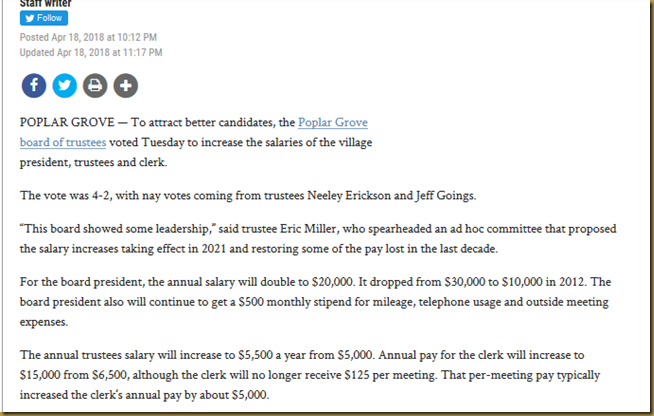
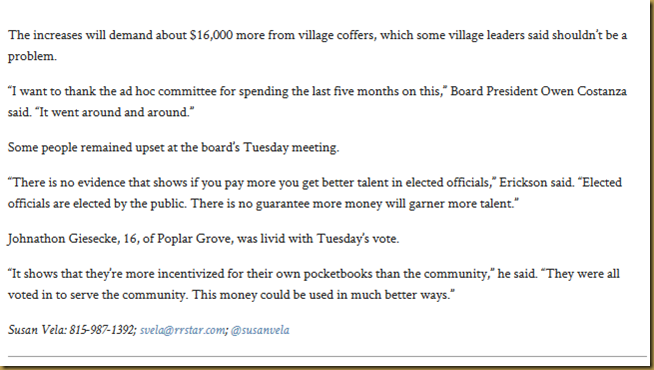
Poplar Grove officials vote themselves an increase in pay


image

image

Above is fromhttp://www.rrstar.com/news/20180418/poplar-grove-elected-officials-will-receive-more-pay-in-2021

Wednesday, April 18, 2018

All Bergners, Carsons, Boston, Youngers will close


image


Liquidation firms win bid for The Bon-Ton Stores

  • By ivan moreno, associated press

MILWAUKEE — Apr 18, 2018, 5:39 PM ET

FILE- This Jan. 31, 2018, file photo shows The Bon-Ton Store at the Millcreek Mall, near Erie, Pa. Two liquidation firms are the victors of an auction for The Bon-Ton Stores companys assets, after the retailer failed to find a bidder willing to contThe Associated Press

FILE- This Jan. 31, 2018, file photo shows The Bon-Ton Store at the Millcreek Mall, near Erie, Pa. Two liquidation firms are the victors of an auction for The Bon-Ton Stores company's assets, after the retailer failed to find a bidder willing to continue operating the business. A bankruptcy court hearing is scheduled for Wednesday, April 18, to approve the sale and liquidation details. (Jack Hanrahan/Erie Times-News via AP, File)more +

The Bon-Ton Stores, which operates 260 department stores in the U.S., is expected to go out of business after two liquidation firms became the highest bidders at an auction for the bankrupt company's assets Tuesday.

A bankruptcy court hearing was scheduled Wednesday to approve the sale and liquidation details, but a statement from the company's CEO suggested the end for The Bon-Ton Stores Inc. is certain.

"While we are disappointed by this outcome and tried very hard to identify bidders interested in operating the business as a going concern, we are committed to working constructively with the winning bidder to ensure an orderly wind-down of operations," said President and CEO Bill Tracy.


The 160-year-old company has survived economic recessions and depressions, but like several other brick-and-mortar retailers in recent years it couldn't survive the shift toward e-commerce, led by Amazon.com Inc.

The Bon-Ton Stores has a strong presence in Wisconsin, where it operates nine stores and employs 2,255 people who will lose their jobs. One of the company's headquarters is in downtown Milwaukee.

"The stores obviously have been a part of this community for decades and decades and it's sad to see them go," said Milwaukee Mayor Tom Barrett.

Liquidation firms Great American Group and Tiger Capital Group were the highest bidders for the company's assets and no one else was willing to outbid them to continue store operations.

The Bon-Ton Stores was operating 260 stores in 24 states, largely in the Northeast and Midwest, when it filed for bankruptcy in January. The stores operate under different names, including Younkers, Boston Store and Carson's.

Cultural retail behemoth Toys R Us is also going through liquidation and in March initiated a going-out-of-business sale at its U.S. stores after operating under bankruptcy protection for months.

"I don't think there are too many willing investors in brick and mortar stores now. They've seen what's going on. I think people are nervous," said Purush Papatla, marketing professor and interim Associate Dean of Academic Affairs at the University of Wisconsin-Milwaukee. "Essentially liquidators have an open field."

The businesses The Bon-Ton Stores has across the country sometimes serve as anchors at malls, and their departure could impact other businesses nearby with less foot traffic, Papatla said.

One Boston Store is located in Milwaukee's Shops of Grand Avenue mall.

"It's part of a national transformation," Barrett said. "Consumer preferences are changing dramatically and changing very fast right now.

Above is from: http://abcnews.go.com/Business/wireStory/liquidation-firms-win-bid-bon-ton-stores-54552305

Tuesday, April 17, 2018

16th Illinois Congressional District

image

Trump is a “Libel Bully”?

In the light of the recent “raid” on President Trump’s personal attorney a re-read of the October 2016 article seemed appropriate and helpful.

NYT: Fearing Trump, Bar Association Stifles Report Calling Him a ‘Libel Bully’

image

By ADAM LIPTAKOCT. 24, 2016

WASHINGTON — Alarmed by Donald J. Trump’s record of filing lawsuits to punish and silence his critics, a committee of media lawyers at the American Bar Association commissioned a report on Mr. Trump’s litigation history. The report concluded that Mr. Trump was a “libel bully” who had filed many meritless suits attacking his opponents and had never won in court.

But the bar association refused to publish the report, citing “the risk of the A.B.A. being sued by Mr. Trump.”

David J. Bodney, a former chairman of the media-law committee, said he was baffled by the bar association’s interference in the committee’s journal.

“It is more than a little ironic,” he said, “that a publication dedicated to the exploration of First Amendment issues is subjected to censorship when it seeks to publish an article about threats to free speech.”

In internal communications, the bar association’s leadership, including its general counsel’s office and public relations staff, did not appear to dispute the report’s conclusions.

But James Dimos, the association’s deputy executive director, objected to the term “libel bully” and other sharp language in the report, saying in an Oct. 19 email that the changes were needed to address “the legitimately held views of A.B.A. staff who are charged with managing the reputational and financial risk to the association.”

“While we do not believe that such a lawsuit has merit, it is certainly reasonable to attempt to reduce such a likelihood by removing inflammatory language that is unnecessary to further the article’s thesis,” Mr. Dimos wrote. “Honestly, it is the same advice members of the forum would provide to their own clients.”

Mr. Trump has made frequent threats in recent weeks to file more lawsuits, including ones against The New York Times for publishing parts of his tax returns and accounts of women accusing him of sexual misconduct. On Saturday, he threatened to sue the women themselves.

Members of the committee expressed dismay with the bar association’s actions.

“It’s colossally inappropriate for the A.B.A. to sponsor a group of lawyers to study free speech issues and at the same time censor their free speech,” said Charles D. Tobin, another former chairman of the committee.

Mr. Dimos did not respond to a request for comment. Carol Stevens, an A.B.A. spokeswoman and a former managing editor of USA Today, said the association had only minor and routine objections to the article’s tone.

“We thought it was an insightful article, and we asked them to consider minor edits,” she said.

George Freeman, a third former chairman of the forum, disputed that characterization.

“I don’t think it’s fair to say ‘minor edits,’ ” he said. “Among the edits they wanted to make were the title and the lede,” he said, using newspaper jargon for the article’s opening passage.

The article was titled “Donald J. Trump Is a Libel Bully but Also a Libel Loser.” The bar association’s proposed title was “Presidential Election Demonstrates Need for Anti-Slapp Laws.” The acronym stands for Strategic Lawsuits Against Public Participation. In states with such laws, defendants can sometimes seek early dismissal of libel and similar suits and recover their legal fees.

Mr. Freeman, a former lawyer at The New York Times Company, is executive director of the Media Law Resource Center, a trade association of law firms and media companies. On Friday, the center posted the report on its site [see note below to read the entire 12 page document]

Ms. Stevens, the bar association spokeswoman, emphatically denied that the fear of a libel suit had played any role in the association’s objections. Ms. Stevens declined to comment when she was read passages from Mr. Dimos’s email. “I’m not a lawyer,” she said, “and that wasn’t my fear.”

Presented with the email, which indicated that she had received it at the time, she pointed to a passage in it that raised another criticism of the study. “Mr. Dimos’s primary concern was the use of partisan language,” Ms. Stevens said. “By policy, the A.B.A. is strictly nonpartisan.”

The study was prepared by Susan E. Seager, a former journalist, a Yale Law School graduate and a longtime First Amendment lawyer. She found seven free speech-related lawsuits filed by Mr. Trump and his companies. They included ones against an architecture critic and his newspaper; a book author and his publisher; a political commentator; a former student at Trump University; two labor unions; a network executive; and a beauty contest contestant.

“It’s based on court records, all of it,” Ms. Seager said in an interview. The report includes 81 footnotes.

The report concluded that Mr. Trump had lost four suits, withdrawn two and obtained one default judgment in a private arbitration when a former Miss Pennsylvania failed to appear to contest the matter.

“Donald J. Trump is a libel bully,” the report concluded. “Like most bullies, he’s also a loser, to borrow from Trump’s vocabulary.”

The bar association sought to eliminate that conclusion, which Ms. Seager said was the point of her report.

“I wanted to alert media lawyers that a lot of these threats are very hollow,” she said.

Ms. Seager said the bar association’s action showed that Mr. Trump’s threats work. “The A.B.A. took out every word that was slightly critical of Donald Trump,” she said. “It proved my point.”

Mr. Tobin said the media law committee, the Forum on Communications Law, had been prepared to publish the report without changes.

“Everyone who looked at it on the forum side felt her conclusions were well founded, were backed up by her scholarship and that the A.B.A. should not be censoring a First Amendment lawyer’s point of view about a current presidential candidate’s litigation tactics,” he said.

Mr. Freeman said the bar association’s actions were also at odds with its larger role. “As the guardian of the values of our legal system,” he said, “the A.B.A. should not stop the publication of an article that criticizes people for bringing lawsuits not to win them but to economically squeeze their opponents.”

Mr. Bodney said the country’s finest media lawyers had been ready to defend the bar association without charge had Mr. Trump chosen to sue.

“If push came to shove, as I recently told an A.B.A. representative, one could surely imagine top-notch libel lawyers standing in line to defend this article against a defamation lawsuit on a pro bono basis,” he said. “Evidently, that wasn’t assurance enough.”

Above is from: http://www.nytimes.com/2016/10/25/us/politics/donald-trump-lawsuits-american-bar-association.html?_r=0

Ms. Seager’s 12 page research paper is available at: http://www.medialaw.org/images/stories/MediaLawLetter/2016/October/Trump_Libel.pdf