Friday, October 6, 2017

Boone County Board discusses the idea of solar farms

Boone County Board discusses the idea of solar farms

By Kourtney Adams |

Posted: Wed 10:23 PM, Oct 04, 2017  |

Updated: Wed 11:11 PM, Oct 04, 2017

BOONE COUNTY, Ill. (WIFR) -- Creating a solar farm where crops normally grow. Some Boone County neighbors are on board and others, not so much.

Men with Cypress Creek Renewables gave a presentation Wednesday night to share basic information about solar development to equip the committee and community with more knowledge, to determine what they want to see as far as regulations for solar development in the county.

These men say they've been working to draft an ordinance to try to build two solar farms in the county, one along Reeds Crossing Road between Genoa and Spring Center Roads, and the other off of Illinois 173, east of Capron. The company has been sending letters to Illinois farmers throughout the region asking for $1,000 an acre for 20 years if they permit to their company. Some local farmers are concerned about losing farm land and agricultural jobs, but the company says this additional tax revenue could help the county and city services.

"The main concern is losing productive farm land. The site that they are looking at is prime agriculture land, we can't reproduce that. The plant comes in, it subsides in for any reason at all, who's going to decommission it? Who's going to take it apart?” says Capron farmer, Julie Newhouse.

"We've actually already held a few community meetings to solicit opinions, questions and concerns from neighboring property owners because everybody's so new to solar in the state, understandably because there's quite frankly just not much solar development, but we did it in an open process so they know that we're not trying to just stick shovels in the dirt as quickly as we can," says Cypress Creek Renewables Senior Developer, Scott Novack.

Wednesday was the beginning stages of talking about solar development in the county. The next step will be to determine what projects the county wants to move forward with. Newhouse believes we already have an excess of electricity in Illinois and don't need more.

Cypress is trying to build at least three solar farms in the region by 20-19. Newhouse says she hopes the county board will take their time with this decision.

Above is from:  http://www.wifr.com/content/news/Boone-County-Board-Member-449520023.html

Wednesday, October 4, 2017

Trump administration ordered to enforce methane restrictions launched under Obama


Evan HalperEvan HalperContact Reporter

The Trump administration was ordered by a federal judge Wednesday to immediately enforce Obama-era restrictions on the release of potent methane emissions at oil and gas drilling operations on public land.

The ruling came at the behest of California and other states, which charged the administration is required by law to enforce the new rules intended to cut the release of 175,000 tons of the potent greenhouse gas annually, as well as reduce the emission of associated toxic pollutants. The rules took effect Jan. 17, just three days before President Trump’s inauguration.

The Interior Department had been delaying enforcement as it mapped out a strategy to rescind the new rules, which industry has complained are onerous. An earlier push by opponents of new methane restrictions to kill them in Congress fell short of the needed votes amid a backlash from environmentalists and landowners adversely affected by pollution from drilling.

The ruling was the latest in a series of legal setbacks for the Trump administration, as the courts find flaws in its plans for dismantling executive branch actions taken under President Obama to confront climate change.

The ruling covers nearly 100,000 oil and gas wells on federally owned land. The methane they leak is one of the most potent accelerators of climate change, 25 times more harmful than carbon dioxide. The new restrictions require the energy companies that own the wells to capture more of the methane and convert it into electricity.

The amount of methane escaping each year is enough to provide electricity for nearly 740,000 homes.

California noted in its lawsuit that delay in enforcing the rules was costing local communities, which are entitled to royalty revenue when the trapped methane is sold to electricity companies. The new rules are expected to generate as much as $23 million in such royalties nationwide.

U.S. Magistrate Judge Elizabeth Laporte in San Francisco ruled the department cannot legally postpone a rule that has already taken effect. She was unconvinced by administration arguments that it would soon have different regulations in place. She ruled that the process of replacing the rules could take months, and ultimately may not stand up to legal challenges.

“No one is above the law,” California Atty. Gen. Xavier Becerra said in a statement. “As a result of this rule’s implementation, oil and gas operators on federal and Indian lands will be compelled to prevent the waste of natural gas.” He added that methane emissions “threaten the health of nearby residents and contribute to climate change.”

California’s lawsuit alleged that the administration suspended the rule five months later without reviewing any public comment or following the other requirements for such a policy change under the federal Administrative Procedure Act.

The Trump administration and congressional Republicans have been under intense pressure from oil and gas companies to scrap the rules. They say the cost of the methane capturing technologies would crush smaller firms, and that the bigger operations that create the most methane are trapping the gas already.

The warnings of economically crushing costs conflicted with Bureau of Land Management findings that the average small business with an oil or gas operation on federal property would see its profit margin reduced by two-tenths of 1% as a result of the rules.

While many prominent Republicans continue to rail against the methane restrictions, including House Majority Leader Kevin McCarthy of Bakersfield, several conservative lawmakers have grown uncomfortable with the effort to kill the rule.

Some of these lawmakers come from states that already have strong restrictions on methane emissions in place. They are contending with pollution from drilling operations in neighboring states with more lenient policies drifting over their borders, undermining the efforts to clean the air.

The court ruling Wednesday was just the latest legal setback for the administration in its effort to weaken federal environmental rules. Approval of a big coal mine expansion in Montana and a major gas pipeline in Florida were blocked in court recently because the administration refuses to calculate their climate impacts and the associated economic costs. The courts also found illegal an effort by the administration to delay new federal rules requiring oil companies to pay the government higher royalties.

“The courts are once again — for at least the fourth time — telling the Trump administration that it cannot simply ignore environmental laws and regulations that are already on the books,” said an email from Kate Kelly, public lands director at the Center for American Progress, a liberal advocacy group. “The administration’s ‘stay and delay’ tactics, through which it is allowing industries to bypass pollution controls and dodge royalty payments, are patently illegal.”

Above is from:  http://www.latimes.com/politics/la-na-pol-trump-methane-20171004-story.html

Solar power is the fastest growing source of global energy

Business


Engadget Rachel England,Engadget 45 minutes ago


Solar power was the fastest-growing source of global energy last year, overtaking growth from all other forms, according to the International Energy Agency (IEA). The spurt is largely attributed to lower prices and changing government policies encouraging a shift away from traditional power sources, such as coal. China, for example, has played an important role in renewable energy's prominence, accounting for almost half of all new solar panels installed worldwide.

Many experts are heralding a "new era" in solar photovoltaics (PV), anticipating that solar PV capacity growth will be higher than any other renewable technology up until 2022. In fact, the IEA has admitted it had underestimated how fast green energy was growing, noting that many countries are set for a solar boom in the coming years. India's renewable energy capacity is expected to double by 2022, overtaking the EU.

However, the IEA has said that despite these encouraging figures, there are uncertainties ahead. Donald Trump's pledge to revive coal has put the country's position as the second fastest-growing renewables market in jeopardy, especially if the US International Trade Commission were to impose tariffs on imports of Chinese solar panels. However the forecast for now, according to the IEA, remains bright.

Above is from:  https://www.yahoo.com/finance/news/solar-power-fastest-growing-source-031600101.html

Wednesday, September 20, 2017

Boone County considers solar ordinance because of Cypress Creek Renewables

BELVIDERE — Farmer Cheryl Sturges received a letter this summer offering $1,000 an acre for 20 years if she permitted Cypress Creek Renewables to put solar panels where crops normally would grow.

While Sturges had no problems refusing, she soon learned at least one neighbor had accepted the company’s deal.

Sturges and about 20 others are mounting a defense to ensure Boone County officials attach a long list of conditions to whatever rules they create for Cypress Creek and other companies that would build solar farms in the county.

“This is definitely an industrial use,” Sturges said. “It definitely is not a farm. That’s where our concern is. What happens if it goes belly up? Who’s going to take care of it? They’re creating jobs. They’re also taking away from the agrarian job market. I’m not totally opposed to it. But this is primary farm ground.”

She has provided the Boone County Planning, Zoning and Building Committee with two pages of concerns and requests that any new solar ordinance mandate the following:

• a decommissioning plan;

• solar panels must not contain hazardous materials; and

• “reasonable” setbacks that include buffering, landscaping and even fencing.

Cypress Creek is supposed to appear at the committee’s October meeting.

The company has been sending letters to Illinois farmers throughout the region. It has been working with Boone County so it can build two more solar farms, the first for Boone County — along Reeds Crossing Road between Genoa and Spring Center roads, and off of Illinois 173, east of Capron.

“If anything is done here, it needs to be workable with the citizens of the community as well as with the farmers,” said Denny Ellingson, the PZB committee’s chairman.

According to Hilary Rottmann, Boone County land use planner, the solar farms would be considered energy facilities generating 1 megawatt or greater. A megawatt is equal to one million watts.

She presented PZB committee members with a spreadsheet earlier this month that detailed how other communities have handled solar proposals. Some ordinances included landscaping buffers, noise buffers and fences.

For example, Kankakee County’s ordinance has decommission requirements including “removal of all development, restoration to condition prior to development, time frame of completion, (guarantee of) financial resources available to fully decommission site, (and) updat(ing) plan every three years.”

“It ultimately goes to the board,” County Administrator Ken Terrinoni said. “It’s very complex. It’s going to take a lot of time” to draft a solar ordinance.

County leaders have said they could attach conditions to any special-use permits considered for Cypress Creek if the solar ordinance takes time to finalize.

“We’re getting a lot of concerned citizens, but we’re not really getting a lot of protest,” Ellingson said.

Boone County has gone through controversial rules governing renewable energy farms before. Chicago-based Mainstream Renewable Power killed its wind turbine plans indefinitely in 2016, saying a more restrictive county ordinance made it too difficult to proceed.

Susan Vela: 815-987-1392; svela@rrstar.com; @susanvela

Above is from:  http://www.rrstar.com/news/20170919/boone-county-considers-solar-ordinance-because-of-cypress-creek-renewables


Wednesday, September 13, 2017

Congress Passes Measure Challenging Trump to Denounce Hate Groups

Congress Passes Measure Challenging Trump to Denounce Hate Groups

The New York Times logoThe New York Times

The New York Times

By GLENN THRUSH3 hrs ago


A white nationalist rally on the grounds of the University of Virginia in Charlottesville.© Edu Bayer for The New York Times A white nationalist rally on the grounds of the University of Virginia in Charlottesville.

WASHINGTON — The House and Senate have unanimously passed a joint resolution urging President Trump to denounce racist and anti-Semitic hate groups, sending a blunt message of dissatisfaction with the president’s initial, equivocal response to the white nationalist violence in Charlottesville, Va. last month.

The resolution passed the Senate without dissent on Monday and was approved without objection by the entire House on Tuesday night. It could be sent to the White House for Mr. Trump’s signature as early as Wednesday.

A White House spokeswoman did not immediately answer a request for comment.

The nonbinding measure specifically singles out for condemnation “White nationalists, White supremacists, the Ku Klux Klan, neo-Nazis, and other hate groups.” That represents a sharp contrast to the president’s first comments after the deadly early August demonstrations in which he assigned equivalent blame for the violence on anti-fascist counter-protesters.

Mr. Trump denounced “hatred, bigotry and violence — on many sides” and argued that many of the protesters who staged a torchlight march to protest the removal of a statue of Robert E. Lee from the University of Virginia campus were “very fine people.”

One of the counter-protesters, Heather Heyer, 32, was killed when a white nationalist demonstrator drove a car into a crowd. Two Virginia State troopers died when their helicopter crashed while monitoring the violence that swept through the usually sedate college town.

The House version of the resolution, introduced by Republican and Democratic House members from Virginia, asks Mr. Trump to “use all resources available to the President and the President’s Cabinet to address the growing prevalence of those hate groups in the United States.”

In a rare show of bipartisan unity, Speaker Paul D. Ryan of Wisconsin and Senator Mitch McConnell of Kentucky, the majority leader, introduced the measure as a joint resolution, which requires a presidential signature. Two Republican congressional aides involved in the process said the intent was to put the president on the record calling out white racism by name.

The text doesn’t include any reference to counter-protesters.

It also calls on Attorney General Jeff Sessions to “investigate thoroughly all acts of violence, intimidation, and domestic terrorism by White supremacists, White nationalists, neo-Nazis, the Ku Klux Klan, and associated groups” and to “improve the reporting of hate crimes” to the F.B.I.

“What happened in Charlottesville was an act of domestic terrorism perpetrated by a white supremacist, one that tragically cut short the life of a young woman, Heather Heyer, who was speaking out against hatred and bigotry,” Senator Mark Warner, Democrat of Virginia and a co-sponsor of the measure, said in a statement. “We will be pressing our colleagues to swiftly and unanimously approve this resolution in order to send a strong message that the United States Congress unconditionally condemns racist speech and violence.”

Above is from:  http://www.msn.com/en-us/news/politics/congress-passes-measure-challenging-trump-to-denounce-hate-groups/ar-AArQh0i?li=BBmkt5R&ocid=spartandhp

Sunday, September 10, 2017

Illinois is a low-outmigration state, and other things you probably didn’t know about people moving in and out of the Land of Lincoln
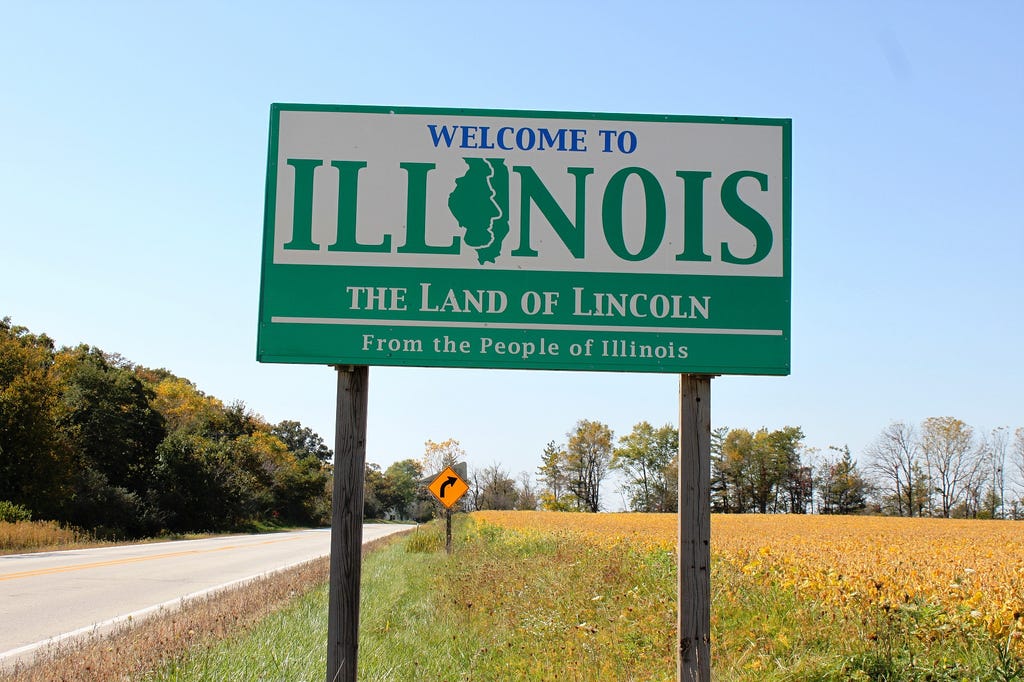


Illinois is a low-outmigration state, and other things you probably didn’t know about people moving in and out of the Land of Lincoln

OZinOZ / flickr

In 2015, about 210,000 Americans moved into Illinois, and about 335,000 Illinoisans moved out of the state. The difference — a net loss of about 125,000 people — became one data point in a growing narrative about the “shrinking” of Illinois. For many people, Illinois’ net outmigration has become a leading indicator of the state’s political dysfunction, cited by observers to justify policy reforms on both the left and the right. The release earlier this year of Census figures for 2016, which showed a similar pattern, set of another spate of similar articles.

But while there’s no denying that the top-level numbers are troubling, the tight focus on just one measure of migration — domestic net migration statewide— has obscured a lot of other important patterns that we might learn from.

For example, close to a third of Illinois’ net domestic migration is eliminated by including immigration from foreign countries. Even more striking, focusing only on negative net migration ignores the roughly 300,000 people who have chosen to move to Illinois in each of the last several years, whose decisions about where to locate in the state might shed some light on what Illinois ought to be doing more of. And looking only on statewide migration — with a few zoom-ins to isolated counties — misses how dramatically different the migration picture is from one part of the state to another.

The rest of this post is an FAQ of sorts that seeks to explain Illinois’ migration situation beyond just the hand-wringing headlines.

Randy von Liski / flickr

Okay, more Americans are moving out of Illinois than into it — is that a new problem?

Nope. A recent report from KDM Consulting found that Illinois has had net negative domestic migration for close to a century: with the exception of a one-year blip in 1947, the last time more Americans moved into the state than out of it was 1920.

Partly, that result is baked into the choice to measure domestic migration. Illinois, like New York, California, and other traditional ports of entry, receives lots and lots of immigrants from abroad. Those people get counted as international in-migrants when they move to the state, but domestic out-migrants when they decide to move from, say, Illinois to Massachusetts. In other words, they don’t make the state look better when they move in, but they make it look worse when they move out. In Illinois’ case, including international immigration offsets about a third of the negative domestic migration.

To get the fuller picture — and because attracting international immigrants has been a crucial part of Illinois’ economic and social health for its entire history — for the rest of this post, we will include international immigration in our figures unless otherwise noted.

Anthony Auston / flickr

So does that mean this is a bunch of hubbub about nothing?

No, there really is a problem. While Illinois has had net negative migration for a long time, things have become decidedly worse in the last several years.

To be fair, some of this change was expected, as people began moving again after hunkering down during the economic insecurity of the 2008 recession.

But Census figures suggest that around 2014, Illinois’ net outmigration numbers suddenly jumped far above recent “normal” levels. In the years between the 2001 and 2008 recessions, Illinois lost, on average, a little over 35,000 people to migration annually. But in 2014, that number reached more than 66,000 people —close to double the pre-recession average — and grew to 83,000 in 2016. Over a decade, the 2016 level would reduce Illinois’ population by close to half a million people, compared to the old “normal.”
Jimmy Emerson / flickr

Are different parts of the state seeing different trends?

In a word: yes.

Historically, Chicago’s suburban collar counties have been the migration powerhouse of the state, hoovering up people from across the country and the world, while relatively few of those suburbanites ended up leaving. Cook County, meanwhile, saw huge net out-migration, as city dwellers moved to the suburbs. And the rest of the state hovered right around the break-even point.

The 2008 recession totally scrambled that old dynamic:

  • The suburban counties, which since the 1990s had been gaining 10 or more new migrants for every 1,000 residents, suddenly fell into the red, losing more movers than they gained by 2010.
  • Cook County, meanwhile, which just before the recession had seen a net loss of 13 migrants per 1,000 residents, improved dramatically. While it never hit positive territory, by 2011, it was actually seeing less net outmigration than the collar counties — a complete reversal of the usual pattern.
  • The rest of Illinois, meanwhile, remained roughly the same as it had been through the worst of the recession.

Since the recovery, things have not returned to normal. The suburbs have remained stuck at negative migration rates close to their mid-recession lows. Cook County’s migration figures are falling deeper into the red — once again below the collar counties, but still significantly better than their pre-recession levels. And the rest of the state, for its part, has actually seen a slow decline.

“The rest of the state” includes everything from Rockford to Carbondale. Can you be more specific?

Sure! Here’s a map of the change in all Illinois counties:

Looking at six of the largest downstate metropolitan areas also shows how much variation has gone into the broad trend of worsening net migration figures since the 2000s. The Quad Cities have had consistently negative net migration since the 1990s; Rockford and Bloomington, on the other hand, had strongly positive net migration until the post-recession era.
Jimmy Emerson / flickr

Do any patterns stand out in downstate counties?

You could probably match migration patterns to any number of demographic or economic variables. But one thing that stood out to us was the presence of public universities.

As you can see, since the 2000s, downstate counties with public universities have seen notably stronger migration than other downstate counties, netting about two additional migrants per 1,000 residents over that period. But they haven’t been immune to the overall pattern of declining downstate migration.

So why are so many people leaving Illinois?

Here’s the thing: Illinoisans aren’t actually more likely to leave their state than residents of other parts of the country.

That’s because “net migration” — what we’ve been talking about this whole time — is made up of two pieces of gross migration: Gross in-migration (all the people who move to a place) and gross out-migration (all the people who leave). Net migration is just the difference between those two numbers.

So bad net migration numbers can be the result of an unusually high number of people leaving, or an unusually low number of people moving in. And in the case of Illinois, it appears to mostly be the second.

In per capita terms, Illinois’ gross out-migration rate ranks just 29th out of the 50 states and the District of Columbia. In other words, Illinois residents are actually less likely to move out than are residents of the median state.

But things don’t look so good when it comes to gross in-migration. Adjusted for population, Illinois attracts fewer newcomers than all but two other states: New York and Michigan.

That means Illinois’ migration problems are mostly about how few people come here, not how many people leave.

Okay, but some people do move to Illinois. Where do they go?

The vast majority, or 70 percent, come to the Chicago metropolitan area: about 44 percent moved to Cook County in 2014, and 26 percent to the collar counties. Champaign County, home to the University of Illinois, comes in after that, at a distant 4 percent.

How much does taxes have to do with it?

It’s common to hear that people leaving Illinois — or avoiding it by not moving here — do so because of high taxes. But generally, researchers find that taxes are relatively low priority factors when people decide to move, falling far below things like being close to family, job markets, and housing costs, which often make a bigger difference in total cost of living than state and local taxes.

In Illinois, some commentators have pointed to a Southern Illinois University poll from October 2016 that found respondents who wished to leave the state cited taxes more than any other single issue. But even in that poll, 73 percent of respondents named an issue other than taxes as the reason for leaving.

On top of that, as you’ve seen, the evidence shows that Illinois’ migration problem isn’t so much about people in the state leaving, as people out of the state choosing not to move here.

Another way of looking at this issue, though, is by examining the relationship between local property taxes and migration in different parts of the state. If taxes are a big reason that people are avoiding Illinois, you’d expect to see that counties with lower property taxes have stronger net migration numbers than counties with higher property taxes.

But in fact, there appears to be barely any relationship between property tax burden and net migration rates in Illinois counties.

And if you look at gross migration, the figures are even more striking. As local property tax burdens increase, gross migration per capita also increases. Counties with property tax burdens more than twice the state median see more than 60 percent more in-migrants per capita than counties with property tax burdens below the state median.

Okay, enough numbers. So what? What have we learned?

Every year, more people choose to leave Illinois than choose to move to it. That fact has taken on a lot of weight as partisans on all sides insist the only way to “stop the bleeding” is to adopt their preferred policies.

But what seems like a straightforward problem is actually much more complicated. Illinois has had net negative domestic migration for nearly a century. There has been a significant deterioration recently, but it seems to be driven by significant regional divergences: The Chicago suburbs, long a migration powerhouse, are no longer, even as Chicago and the Cook suburbs are performing somewhat better than they did in previous decades.

A closer look also shows that what has been interpreted as a problem of too many people leaving is actually a problem of too few people arriving. Illinois does not have an unusually high out-migration rate: it has an unusually low in-migration rate. While it’s of course worth trying to keep people from leaving the state, Illinois’ migration problem won’t really be addressed until we figure out why people don’t want to come here.

And while taxes are a common go-to scapegoat for net negative migration numbers, there is little empirical evidence to suggest that they are what’s driving Illinois’ migration problem.

What is, then? That’s still up for debate. But hopefully this post will help those of us who care about the future of Illinois ask better questions to get the answers we’re looking for.

Above is from:  https://budgetblog.ctbaonline.org/illinois-is-a-low-outmigration-state-and-other-things-you-probably-didnt-know-about-people-moving-ce3f0cd6ab4c

Thursday, September 7, 2017

Rauner will borrow $6 billion to start paying off Illinois pile of unpaid bills

BY Kim Geiger and Monique Garcia Contact Reporter Chicago Tribune

Republican Gov. Bruce Rauner announced plans Thursday to borrow $6 billion to work on paying down Illinois' massive backlog of unpaid bills, but he warned that he'll try to trim state spending in order to pay for the new debt costs.

The move comes months after Democrats and some Republicans gave the governor the borrowing authority as part of a budget they enacted over his objections.

ADVERTISING

Rauner initially resisted taking advantage, contending that there wasn't money included in the budget to make payments on new debt. Democrats dispute that, saying $350 million was set aside for that purpose.

Democrats tried to raise pressure on the governor this week, pointing to a late-August report that estimated that the state could save as much as $6 billion by selling bonds to pay down a portion of its about $14 billion backlog of bills. The report by the Commission on Government Forecasting and Accountability also estimated that the state is paying $2 million in additional costs per day on the portion of those bills that are accruing interest.

Democratic Comptroller Susana Mendoza sent out a statement Wednesday charging that Rauner's delay in issuing the bonds had already cost taxpayers $120 million.

On Thursday, Rauner said in a news release that he had decided to proceed with the bond sale after concluding that "it's better to have Wall Street carry our debt than Main Street Illinois."

Unpaid bills can accrue as much as 12 percent interest per year. The state can more than cut that rate in half, even with its low credit rating, by refinancing the debt in the bond market.

Rauner win on schools bill comes at a price

In announcing his plans, Rauner held out the possibility that his office could make cuts to state spending, though he did not spell out what programs would be on the chopping block.

"The legislature-passed budget did not account for the increase in debt service costs to cover the bill backlog bond issuance," the Rauner statement said. "The governor's office is identifying several hundred million dollars in possible spending reductions to address this budgetary shortfall. The governor also would like the General Assembly to return to Springfield this fall to work with him to balance the budget and enact structural reforms that could save much more."

Rep. Greg Harris, a key budget negotiator for House Democrats, said Rauner's read of the budget legislation is incorrect. He said $350 million was set aside to help pay for the borrowing.

The budget gives the state the authority to issue up to $6 billion in general obligation bonds that must be issued by the end of the calendar year. The money raised must be used to pay down expenses that were incurred during the two-year budget stalemate that ended in July. That's when lawmakers overrode Rauner's veto of the budget, enacting it.

Rauner vetoes bills on spending transparency, home health care worker OT

Harris, of Chicago, said he was glad Rauner decided to move forward with the borrowing plan, which he credited to pressure put on the governor by Mendoza.

"His delay has cost us over $120 million in interest that could have been spent on actual services to the people of Illinois. But instead, he has essentially thrown it into the middle of the plaza at the Thompson Center and lit it on fire," Harris said.

Mendoza, whose job is to manage cash flow in the state's main checking account, praised the decision.

"Refinancing our debt at a much lower interest rate — just like any sensible homeowner with a high mortgage rate would do — will provide payment for services rendered to thousands of people across the state and save Illinois taxpayers billions of dollars over the life of the bonds," she said in a statement.

Also on Thursday, Mendoza announced that she had released $541 million in state aid payments to schools, bringing the state current on two payments that had been due in August. They were delayed because of the fight between Rauner and lawmakers over education funding formula legislation. That dispute was resolved last week.

kgeiger@chicagotribune.com

mcgarcia@chicagotribune.com

Above is from:  http://www.chicagotribune.com/news/local/politics/ct-bruce-rauner-bond-sale-met-20170908-story.html