Thursday, January 15, 2015

Majority of Republicans Believe in Regulating Emissions - Pacific Standard: The Science of Society


On the heels of last year’s Pew study showing that the majority of Americans believe in climate change, researches at Yale University have further blurred the lines by demonstrating that the majority of Republicans do in fact support the reduction of carbon pollution.

By polling a wide range of Republicans—liberal leaning, moderate, conservative, and Tea Party members—researchers have shown that, overall, 56 percent of Republicans support regulating carbon dioxide as a pollutant. Predictably, the subdivided percentages reflect how far right each group leans: 71 percent of liberal Republicans and 74 percent of moderate Republicans believe carbon dioxide should be regulated, while only 54 percent of conservatives and 36 percent of Tea Party Republicans do.

When the Atlanta Tea Party, for example, joined with the Sierra Club in 2013 to argue for Georgia homeowners’ right to install solar roofing panels, there was party philosophy—though not necessarily environmental—at play.

However, when asked about their thoughts on global warming in general, the party was a bit more hesitant. While the majority of self-identified liberal and moderate Republicans believe global warming is real—68 percent and 62 percent, respectively—that number drops to 38 percent of conservative Republicans and a dismal 29 percent of Tea Partiers.

To reach these numbers, Yale’s Project on Climate Change Communication aggregated data from six national surveys, conducted between 2012 and 2014. In all, responses from 5,513 registered voters—2,330 of whom identified as Republican or Republican-leaning—were taken into account. The survey incorporated all socioeconomic groups (researchers even provided laptops and Internet access to a portion of the panel).

Read the entire article:  Majority of Republicans Believe in Regulating Emissions - Pacific Standard: The Science of Society

Lino’s to be honored by Illinois Office of Tourism | The Rock River Times

image

image

Online Staff Report

Lino’s Restaurant, 5611 E. State St., Rockford, will be honored by the Illinois Office of Tourism and the Rockford Area Convention & Visitors Bureau for its more than 40 years of serving fine Italian cuisine.

An award presentation will be made at 2 p.m., Thursday, Jan. 15, at the restaurant.

Learn more about the restaurant and view its menu online at linosrockford.com. Lino’s can be reached at (815) 397-2077.

Posted Jan. 14, 2015

Lino’s to be honored by Illinois Office of Tourism | The Rock River Times

Another Text Amendment on Wind—a half mile setback?

Mr. Cleverdon and Ms. Kenney submitted a text amendment proposal to Boone County which would drastically change the setback requirements--from the current 1,000 feet to over a half a mile --allowing for no variances. The effective set back for a 500 feet tower-- increased from 1,000 feet to 3,300 feet.

The only meeting which a member of the public will be guaranteed the opportunity to speak/testify is on January 27.

This case may well be rushed through because it is anticipated that Mainstream will have an application submitted for a project for the Northern part of the county this Spring. 
The major changes in the ordinance are on Page 1 and Page 4, Section 4.8.1—Purpose and Section 4.8.6.H Setbacks  See the Green highlight markings.


Page A.
2015 Text amendment on wind   A
Page B
2015 Text amendment on wind   b
Page 1
2015 Text amendment on wind   Page 1
Page 2
2015 Text amendment on wind   Page 2
Page 3
2015 Text amendment on wind   Page 3
Page 4
2015 Text amendment on wind   Page 4
Page 5
2015 Text amendment on wind   Page 5
Page 6
2015 Text amendment on wind   Page 6
Page 7
2015 Text amendment on wind   Page 7
Page 8
2015 Text amendment on wind   Page 8
Page 9
2015 Text amendment on wind   Page 9
2015 Text amendment on wind   Page 10

Tax Justice Blog


January 7, 2015 11:24 AM
By Richard Phillips, Research Analyst at CTJ | Permalink | Bookmark and Share

The new budgetary mantra of the House GOP appears to be: if you can't make the math add up, change the rules of math.

On Tuesday the House did exactly that with its passage of a new rule requiring the non-partisan Congressional Budget Office (CBO) and the Joint Committee on Taxation (JCT) to use "dynamic scoring" rather than static scores for official cost estimates on proposed tax changes. Dynamic scoring is a controversial method of assessing the effect of tax cuts. It allows lawmakers to claim that a tax reform proposal is revenue neutral, even if it would lose revenue under a conventional score.

Read more...

Tax Justice Blog

Executive Summary | The Institute on Taxation and Economic Policy (ITEP)


Read Full Report

The 2015 Who Pays: A Distributional Analysis of the Tax Systems in All Fifty States (the fifth edition of the report) assesses the fairness of state and local tax systems by measuring the state and local taxes that will be paid in 2015 by different income groups as a share of their incomes.1 The report examines every state and the District of Columbia. It discusses important features of each state’s tax system and includes de­tailed state-by-state profiles that provide essential baseline data to help lawmakers understand the effect tax reform proposals will have on constituents at all income levels.

The report includes these main findings:

Virtually every state tax system is fundamentally unfair, taking a much greater share of income from low- and middle-income families than from wealthy families. The absence of a graduated personal income tax and overreliance on consumption taxes exacerbate this problem.

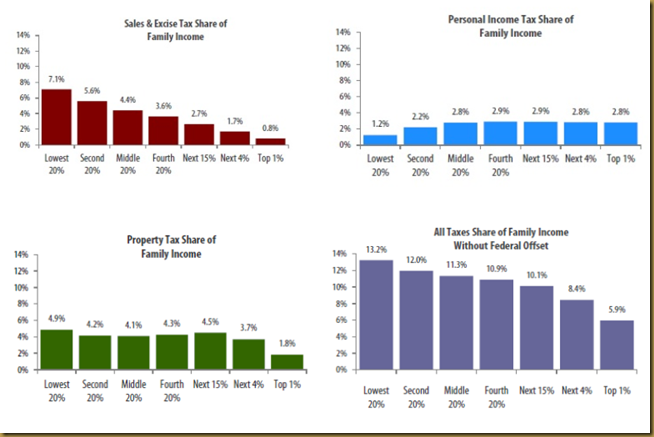
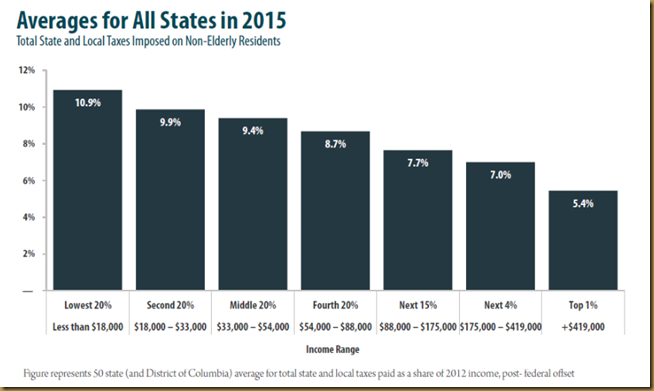
The lower one’s income, the higher one’s overall effective state and local tax rate.Combining all state and local income, property, sales and excise taxes that Americans pay, the nationwide average effective state and local tax rates by income group are 10.9 percent for the poorest 20 percent of individuals and families, 9.4 percent for the middle 20 percent and 5.4 percent for the top 1 percent.

• In the 10 states with the most regressive tax structures (the Terrible 10) the bottom 20 percent pay up to seven times as much of their income in taxes as their wealthy counterparts. Washington State is the most regressive, followed by Florida, Texas, South Dakota, Illinois, Pennsylvania, Tennessee, Ari­zona, Kansas, and Indiana.

Heavy reliance on sales and excise taxes are characteristics of the most regressive state tax systems. Six of the 10 most regressive states derive roughly half to two-thirds of their tax revenue from sales and excise taxes, compared to a national average of roughly one-third . Five of these states do not levy a broad-based personal income tax (four do not have any taxes on personal income and one state only applies its personal income tax to interest and dividends) while four have a personal income tax rate structure that is flat or virtually flat.

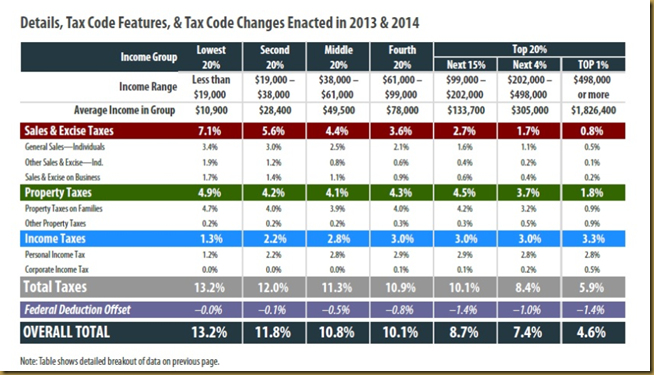
State personal income taxes are typically more progressive than the other taxes that states levy (e.g property, consumption). Sales and excise taxes are the most regressive, with poor families paying almost eight times more of their income in these taxes than wealthy families, and middle income families pay­ing five times more. Property taxes are typically regressive as well, but less so than sales and excise taxes.

Personal income taxes vary in fairness due to differences in rates, deductions, and exemptions across states. For example, the Earned Income Tax Credit improves progressivity in 25 states and the District of Columbia, while nine states undermine progressivity by allowing taxpayers to pay a reduced rate on capital gains income, which primarily benefits higher-income households.

State consumption tax structures are highly regressive with an average 7 percent rate on sales and excise taxes for the poor, a 4.7 percent rate for middle-income people, and a 0.8 percent rate for the wealthiest taxpayers. Because food is one of the largest expenses for low-income families, taxing food is particularly regressive; five of the ten most regressive states tax food at the state or local level.

Taxes on personal and business property are a significant revenue source for both states and locali­ties and are generally regressive in their overall effect, particularly for middle-income households. A homestead exemption (exempting a flat dollar or percentage amount of property value from a property tax) lessens regressivity. A property tax circuit breaker that caps the amount a property owner pays in property taxes based on their personal income can also reduce regressivity; none of the 10 most regres­sive states offer this tax break to low-income families of all ages.

States commended as “low tax” are often high tax states for low- and middle-income families. The 10 states with the highest taxes on the poor are Arizona, Arkansas, Florida, Hawaii, Illinois, Indiana, Pennsylvania, Rhode Island, Texas, and Washington. Seven of these are also among the “terrible ten” because they are not only high tax for the poorest, but low tax for the wealthiest.

Read more go to:  Executive Summary | The Institute on Taxation and Economic Policy (ITEP)
 

image

image

More Illinois facts: 

image

image

Illinois: Gov. Pat Quinn lost his bid for reelection to businessman Bruce Rauner. Taxes were a big issue in this campaign. Rauner’s position on how to handle the state’s temporary 5 percent income tax rate changed through the campaign. (The state’s temporary 5 percent income tax rate is set to fall to 3.75 percent in January). Initially he proposed allowing the temporary income tax hike to immediately expire, but he changed his position once the reality set in that as governor he would need to fill the $2 billion budget hole created by allowing the tax rate to fall. More recently, Rauner has said that he will allow the temporary tax increase to expire over four years and will keep property taxes at their current level. Rauner would make up $600 million of lost income tax revenue by broadening the sales tax base to include many business services such as advertising, printing and attorney fees. The Illinois House and Senate, which remain under Democratic control, may tackle the temporary income tax rate before Rauner takes office. Regardless, Illionois will be a state to watch in 2015 given the governor’s stand on taxes, divided government and  overwhelming voter approval of a referendum showing support for a millionaire’s tax.

Wednesday, January 14, 2015

White House Says U.S. Broadband Market Needs More Competition | Re/code

President Obama said Tuesday night that he wants to make it easier for local communities

to build their own high-speed Internet networks because U.S. broadband services are too expensive and there isn’t enough competition in many areas.

In a video posted on YouTube to preview a broadband-related event in Iowa Wednesday, President Obama said that every community should “be able to be to make the investments they need to speed up broadband, bring in more competition (and) give consumers more choice.”

In reality, the White House isn’t offering much new. Federal Communications Commission chairman Tom Wheeler is already expected  to approve requests from two cities in coming months to preempt state laws limiting local communities from building their own networks. And while White House officials announced the Agriculture Department will provide $40 million to $50 million in loans this year to rural broadband providers, that agency has offered similar loans for years.

White House officials declined to comment on what their concerns about the lack of competition in the broadband market means for Comcast’s* $45 billion deal to acquire Time Warner Cable, which would give the cable giant upwards of 38 percent share of the national consumer high-speed broadband market.

But President Obama’s trip to Iowa Wednesday to promote the administration’s efforts to improve U.S. broadband service and its inclusion in next week’s State of the Union can’t be great news for Comcast or other U.S. broadband providers, which are still reeling from the president’s November endorsement of stricter net neutrality rules for Internet lines. Wheeler is expected to propose those rules in early February.

“What we’re saying is that Americans should have options for better, faster broadband,” said Jeff Zients, director of the National Economic Council, in a call with reporters.

In a fact sheet, the White House noted that “three out of four Americans have no competition or no service at speeds increasingly required for many online services.” That echoes remarks Wheeler made last September when he called the market uncompetitive. Last week, the FCC suggested lifting the current definition of broadband service from 4 Mbps to 25 Mbps.

President Obama will be in Cedar Falls, Iowa on Wednesday to announce a variety of proposals aimed at improving broadband access and affordability for more Americans, mostly by making it easier for communities to build their own competing networks or partner with companies like Google, which is slowly expanding its fiber network.

Cedar Falls Utilities is a locally owned municipal broadband service which launched years ago. It began providing gigabit Internet speeds to local residents two years ago and has been held up as a model program by municipal broadband advocates trying to encourage the spread of locally owned networks.

Internet providers have mostly fought such locally owned systems, particularly ones which would be built in areas where local phone and cable companies offer services. Thanks in part to lobbying by Internet providers, there are laws in 19 states restricting municipalities from funding competing systems.

Aside from concerns by competitors, there have been a few cases where locally owned systems have run into financial trouble, since it’s extremely expensive to build fiber networks and incumbent Internet providers in some cases have cut their prices to retain customers.

In a case study last year about the Cedar Falls system, two New York Law School researchers concluded that the city’s municipal broadband project could be difficult for other areas to replicate. Cedar Falls officials were willing to risk taking on “a significant amount of debt with limited evidence that consumers wanted ultra-fast Internet connections” which resulted in financial volatility and a credit downgrade, they said.

White House officials announced Tuesday night that 50 cities have joined a coalition to push for expanding municipal broadband service. The White House also plans to hold a summit in June focused on expanding locally owned broadband networks.

*Comcast’s NBCUniversal unit is a minority investor in Revere Digital, Re/code’s parent company

White House Says U.S. Broadband Market Needs More Competition | Re/code

Tuesday, January 13, 2015

Chinese-made Volvo to be China's first car export to US - Yahoo News

image

Detroit (AFP) - China's first-ever car export to the United States is going to be a Chinese-made Volvo, the company announced.

Hakan Samuelson, president and chief executive officer of the Volvo Car Group, said Monday that the company will begin shipping a new S60 model produced in China to the US market in mid-year.

The move will be a landmark for Volvo, which was bought by China's Geely Holding auto group in 2010.

The S60 will be built at a brand new factory in Chengdu that was developed to help launch the Volvo brand in the Chinese market.

Samuelson said the factory where the S60 is being built uses the very latest technology and operates on the strict standards laid down by Volvo.

"It's built like a Volvo in every way. You can't tell the difference between a Volvo built in China and Volvo built in Gothenborg (Sweden) or Ghent (Belgium)," Samuelson said.

Sales personnel in Volvo's dealerships around the US will be coached to make the same point, he said, given the potential scepticism that could greet a made-in-China vehicle.

However, the long-wheel base S60 will not be exported to Europe from China because of regulations and tariffs, he said.

Samuelson told AFP that Volvo is in the midst of overhauling its product line in the United States. Volvo's US sales dropped 8 percent to just over 56,000 units last year, according to AutoData.

Chinese-made Volvo to be China's first car export to US - Yahoo News